
Kibbe Body Type and Weight: How to Find Your Type at Any Size
Does weight change your Kibbe body type? Learn how to identify your Kibbe type at any size, understand weight gain patterns for all 13 types, and get practical styling tips.
If you have ever thought, "I gained weight and now I cannot figure out my type anymore," you are not alone. This is one of the most common struggles in Kibbe communities, especially for people searching terms like kibbe body type weight, kibbe body type overweight, or how to find kibbe type when overweight.
The key point is simple: weight change does not equal type change.
Your Kibbe Image ID is built on your frame, proportions, and yin-yang balance. Weight can blur the visual clues, but it does not rewrite the architecture underneath.
In this guide, you will learn:
- Why your Kibbe type stays the same across weight changes
- Why typing can feel harder at a higher weight
- Kibbe weight gain patterns for all 13 types
- A practical 4-step method to find your type at any size
- Real styling rules that work for kibbe body types plus size
Not sure where to start? Take our free Kibbe body type test and come back with your top results.
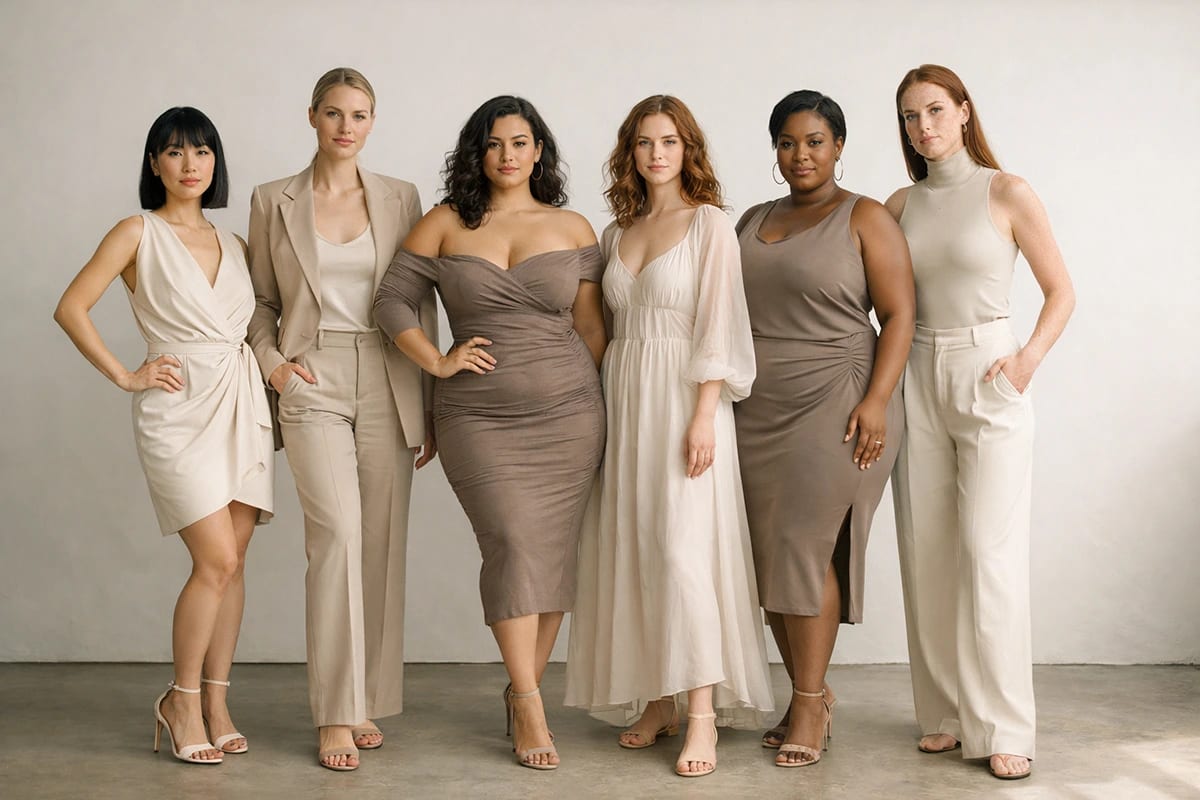 Kibbe works at every size. The goal is line harmony, not shrinking yourself into a type.
Does Your Kibbe Body Type Change When You Gain or Lose Weight?
Short answer: No.
If you are asking, "Does weight affect Kibbe type?" the precise answer is this:
- Weight affects how clearly your lines appear.
- Weight does not change your underlying Image ID.
Kibbe is not a body-fat system. It is a line-and-structure system. Bone structure, vertical line, and your overall yin-yang balance remain stable even when your size changes.
What does change is visibility. At a higher weight, your shoulders may look softer, your waist may look less defined, and your silhouette may look rounder. That can make you think you switched from a yang-leaning type to a yin-leaning one, but often the core frame is still the same.
This is why many people feel "between types" after weight fluctuations. They are not between types. They are between clarity levels.
There is also a mental piece. Many people dealing with body image stress report that self-typing becomes harder because they can no longer see themselves objectively. When that happens, use evidence-based checks (height limits, skeletal points, clothing line tests) instead of mirror anxiety.
If you feel stuck, use two tools together:
- The Kibbe quiz for structured questions
- The type comparison chart for side-by-side line analysis
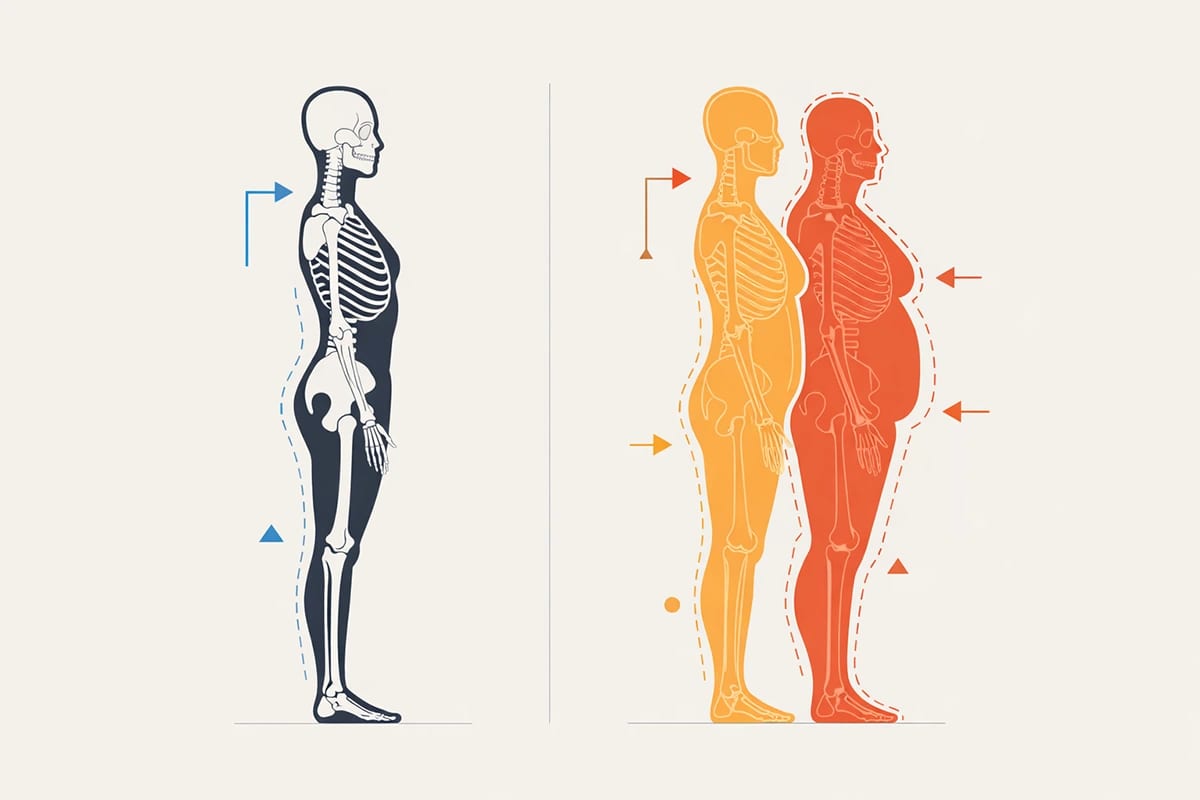 Weight changes flesh distribution. It does not replace your frame geometry.
Why Typing Yourself Feels Harder at a Higher Weight
1. Flesh Obscures Bone Structure
At a higher weight, the clues used for typing can be less obvious:
- Shoulder edge can look less crisp
- Collarbones and wrist shape can be less visible
- Jawline can look softer
- Limb line can look less angular or less elongated
This is where many mistypes start. For example, a Natural-family shoulder can look rounded when softened by flesh, which may be misread as a Romantic-family softness.
2. Weight Gain Creates "False Curves"
One of the biggest Kibbe mistakes is confusing:
- Body curve (fat distribution and silhouette fullness)
- Kibbe curve (how line flows from your frame in garment geometry)
A yang-dominant person can gain weight and look visually curvier, yet still need straighter, longer, or broader line accommodation in clothing. This is why "I look curvy now" is not enough to switch yourself into a yin category.
3. Self-Perception Shifts Under Stress
Many people in Kibbe forums describe this exact issue: body dysmorphia or weight-related stress makes objective typing almost impossible.
When you feel emotionally close to your body data, use external structure:
- Take neutral full-length photos in fitted basics
- Review with one trusted, neutral friend
- Compare clothing outcomes, not just body impressions
You will usually get better answers from "Which outfit lines work?" than from "What do I think my body looks like today?"
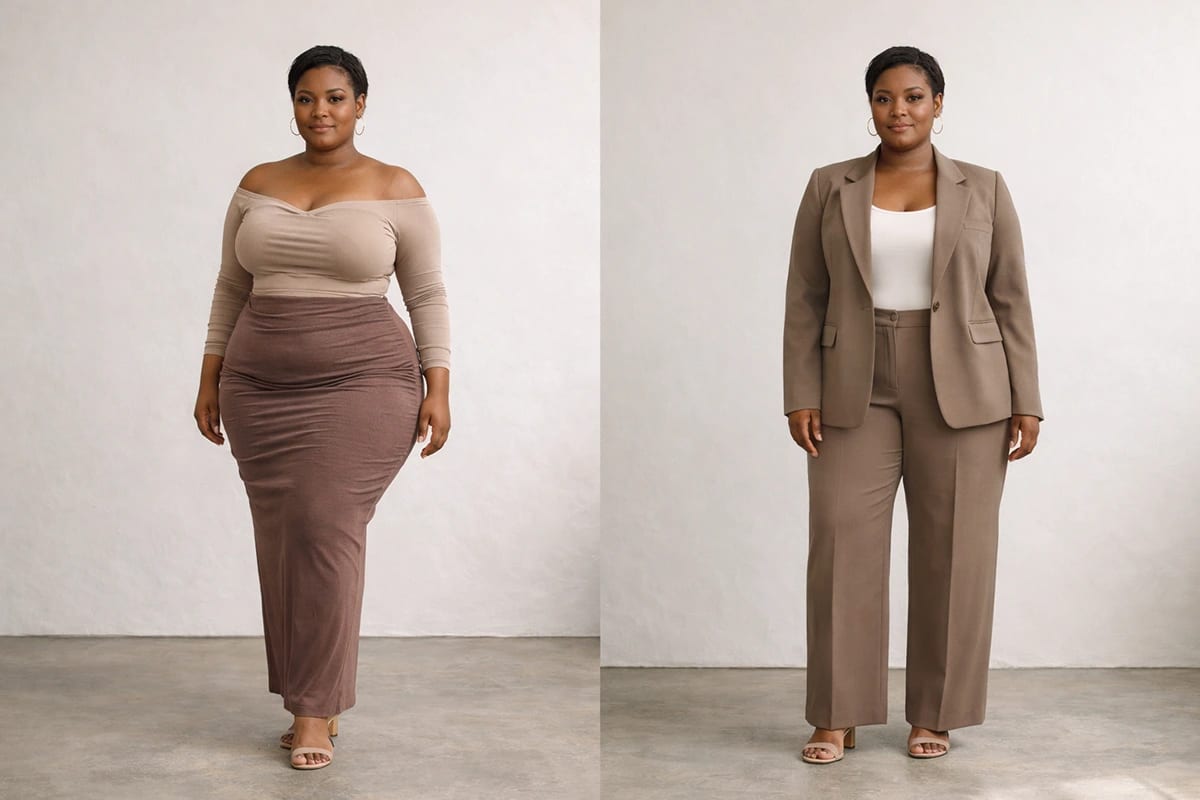 False curves can mislead typing. Clothing line response reveals the deeper pattern.
Weight Gain Patterns for All 13 Kibbe Body Types
David Kibbe discussed recurring gain tendencies in Metamorphosis, and many modern stylists still use those trends as supporting clues. Use this section as a secondary filter, not your only typing method.
Dramatic Family (D, SD)
- Dramatic (D): Gain often shows from the hips and upper thighs first, while upper body can stay comparatively straighter.
- Soft Dramatic (SD): Gain often appears all over, especially bust, upper arms, hips, thighs, and face, while vertical presence remains.
Natural Family (FN, N, SN)
- Flamboyant Natural (FN): Gain can read as broader or squarer overall, sometimes with facial puffiness.
- Natural (N): Often stays relatively straight through the body, with waist thickening rather than dramatic curve creation.
- Soft Natural (SN): Softness can increase quickly in upper arms, waist, and thighs; body can look visibly plusher.
Classic Family (DC, C, SC)
- Dramatic Classic (DC): Gain may collect more below the waist, creating a mild pear tendency while balance stays visible.
- Classic (C): Gain tends to distribute evenly and symmetrically.
- Soft Classic (SC): Overall silhouette softens and waist definition can fade early.
Gamine Family (FG, G, SG)
- Flamboyant Gamine (FG): Gain can look squarer or stockier, often with more weight below the waist.
- Gamine (G): Weight often appears in hips and waist without creating lush yin curve.
- Soft Gamine (SG): Soft roundness can increase in bust and hips; many SGs feel "larger than they are" visually.
Romantic Family (TR, R)
- Theatrical Romantic (TR): Hourglass impression often remains, with visible waist relative to bust/hip fullness.
- Romantic (R): Gain tends to read as all-over softness and roundedness.
Important Caveat
Do not force your body to match these patterns perfectly. Real bodies vary by genetics, hormones, age, training history, and health factors.
Use this order of evidence:
- Height and vertical limits
- Bone structure and line accommodation
- Clothing harmony test
- Weight gain pattern cross-check
How to Use Weight Gain Patterns Without Mistyping Yourself
If you want to use kibbe weight gain patterns correctly, treat them like a probability tool.
Use this quick framework:
- Write down your top 3 candidate types from structure and height
- Compare your long-term gain tendency to those candidates
- Keep only the candidates that match both line tests and pattern trends
Example:
- If you test as FN, SN, and SD from clothing,
- and your gain pattern is all-over softness with strong bust and hip fullness,
- SD or SN usually stays more likely than FN.
Another example:
- If you test as DC, SC, and SG,
- and your gain appears very even and symmetrical,
- C-family logic (DC or SC) generally beats SG.
This is how you avoid overreacting to one body region. A single feature like "I gain in my hips" is too weak alone. A pattern is useful only when it supports what your line tests already show.
When conflict happens, trust this tie-break order:
- Clothing line harmony in full outfits
- Vertical and width requirements
- Weight gain pattern
If needed, revisit your likely family first:
- Dramatic and Soft Dramatic overview
- Natural family overview
- Classic family overview
- Gamine family overview
- Romantic family overview
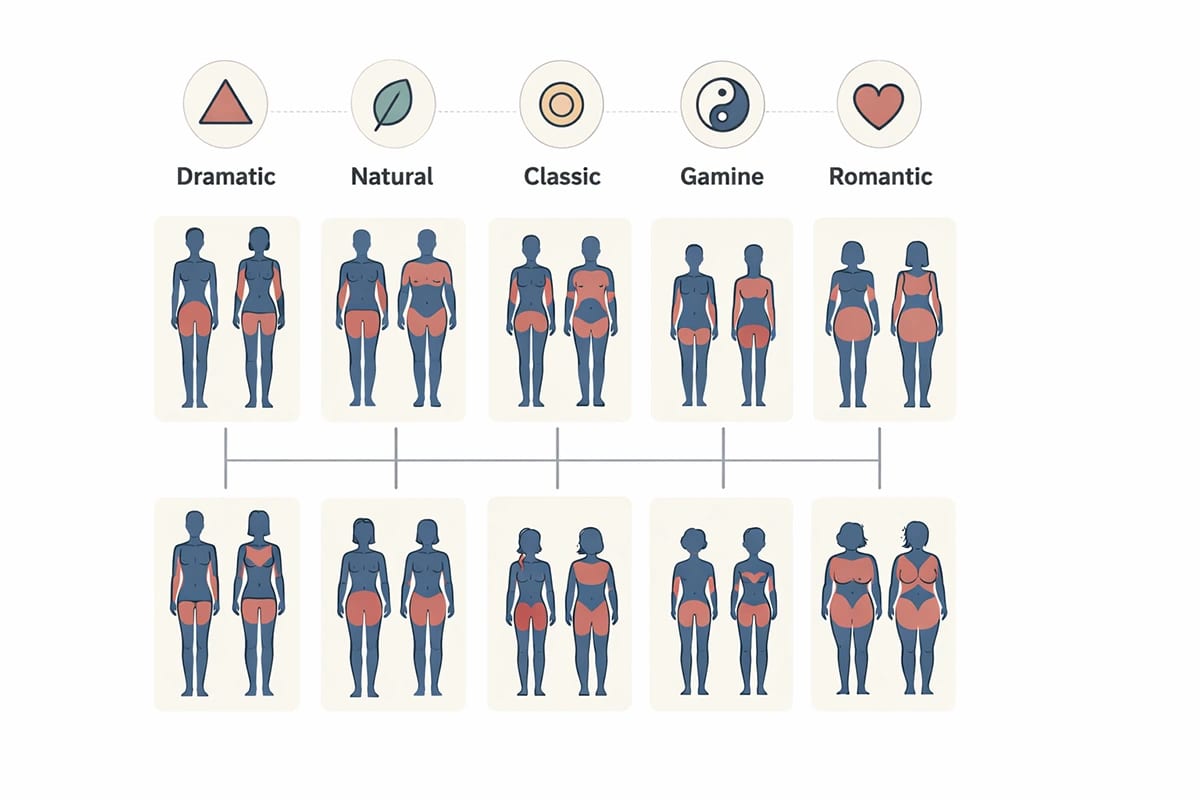 Weight gain patterns by family: useful clues, never final verdicts.
How to Find Your Kibbe Type at Any Weight: A Practical Guide
If you need a clear system, use this four-step method.
Step 1: Focus on Skeleton, Not Flesh
Check the points least affected by weight:
- Shoulder width and edge quality (sharp, blunt, rounded, balanced)
- Hand and wrist impression (long/narrow, broad/blunt, delicate/moderate)
- Collarbone and upper chest geometry
- Overall proportion rhythm (long, moderate, compact)
You are identifying your line architecture, not judging your body.
Step 2: Use the Clothing Test Instead of the Mirror Test
Mirror-only typing easily turns emotional. Clothing testing is more objective.
Try three outfit directions:
- Long, uninterrupted vertical lines
- Relaxed width and unconstructed ease
- Soft waist emphasis with rounded detail
Notice which direction makes you look coherent, balanced, and "finished."
Then jump into detailed recommendations for that candidate family:
- Dramatic style guide
- Soft Natural style guide
- Soft Classic style guide
- Soft Gamine style guide
- Romantic style guide
Step 3: Eliminate by Height and Vertical First
This single filter removes many wrong options quickly.
- If you are around 5'7"+, your strongest candidates are usually D, SD, FN.
- If you are clearly petite in line (often around 5'4" and under), Gamine and Romantic families become stronger candidates.
- Moderate heights need deeper line testing, especially around width vs curve vs balance.
Height is not everything, but ignoring it creates avoidable confusion.
Step 4: Use the Quiz With Honest Inputs
Take the free Kibbe quiz with neutral photos and, if possible, a trusted friend to answer structural questions.
Then verify results against:
- The all 13 types guide
- The side-by-side chart
- Your real clothing outcomes in daily life
That three-part confirmation loop is far more reliable than endless self-guessing.
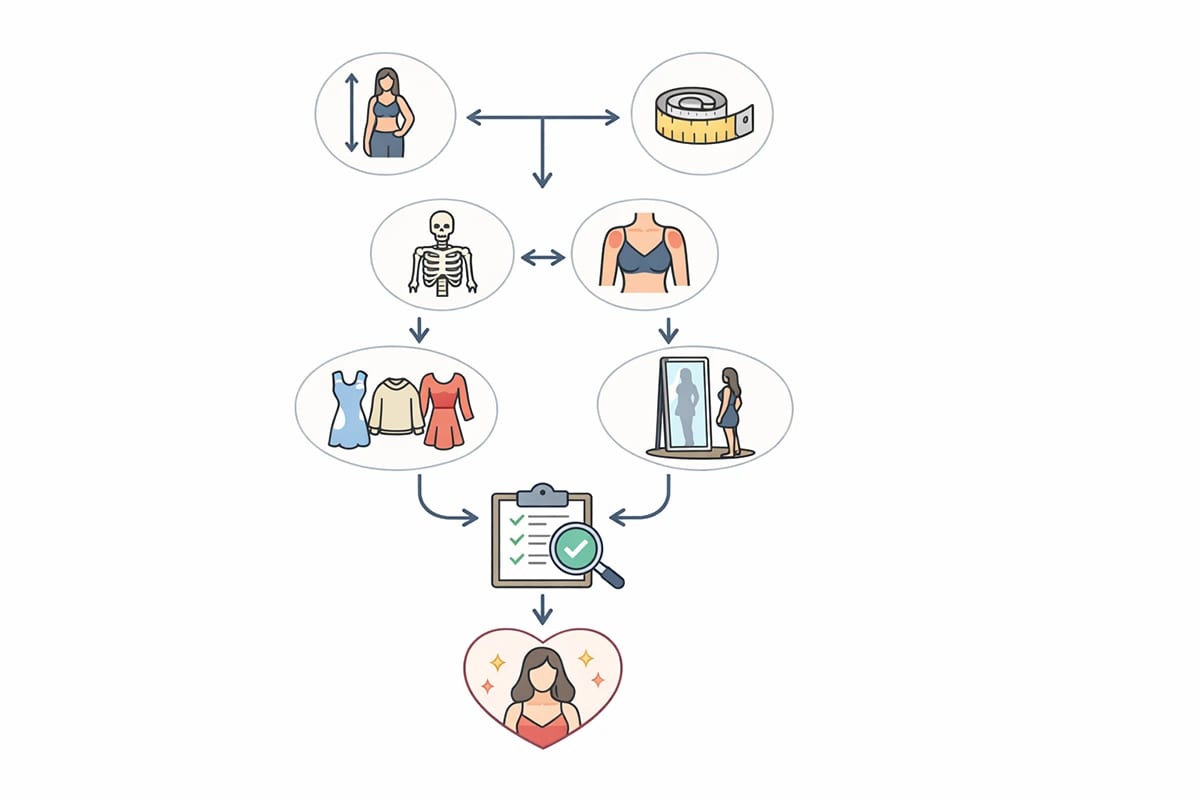 A practical decision flow: structure first, line test second, quiz and chart confirmation third.
Styling Tips That Work at Every Size
This section is for people searching kibbe body types plus size and wanting practical, wearable guidance.
For Yang-Dominant Types (D, FN, DC) at a Higher Weight
Core rule: keep architectural clarity.
- Preserve vertical or structured lines; avoid chopping the body into too many visual sections.
- Choose fabrics with shape memory: ponte, suiting, denim with structure, crisp cotton.
- Keep details clean and intentional.
High-value pieces:
- Longline blazer with shoulder definition
- Straight or wide-straight full-length trousers
- Structured midi dress with vertical seaming
- Clean column knit set in medium-weight fabric
Useful guides:
For Yin-Dominant Types (R, TR, SG, SC) at a Higher Weight
Core rule: define, do not hide.
- Use waist emphasis (seaming, wrap structures, belts that follow natural waist placement).
- Prefer drape with support: matte jersey, fluid crepe, soft knits with recovery.
- Keep shape close enough to show line continuity without compression.
High-value pieces:
- Wrap or faux-wrap dress with controlled drape
- Soft blouse with gentle waist shaping
- Skirt with rounded movement and clean waist finish
- Structured-under-soft cardigan or jacket combo
Useful guides:
- How to dress Romantic
- How to dress Theatrical Romantic
- How to dress Soft Gamine
- How to dress Soft Classic
For Balanced or Mixed Types (N, SN, C, FG) at a Higher Weight
Core rule: avoid extremes.
- Avoid both stiff over-tailoring and oversized shapeless volume.
- Aim for controlled ease: enough room for comfort, enough structure for line.
- Use medium-weight textures and proportion-aware layering.
High-value pieces:
- Relaxed-structured jacket with clean shoulder
- Straight ankle-to-full trousers with soft drape control
- Knit top + matching outer layer with subtle line breaks
- Midi dress with light waist suggestion and practical movement
Useful guides:
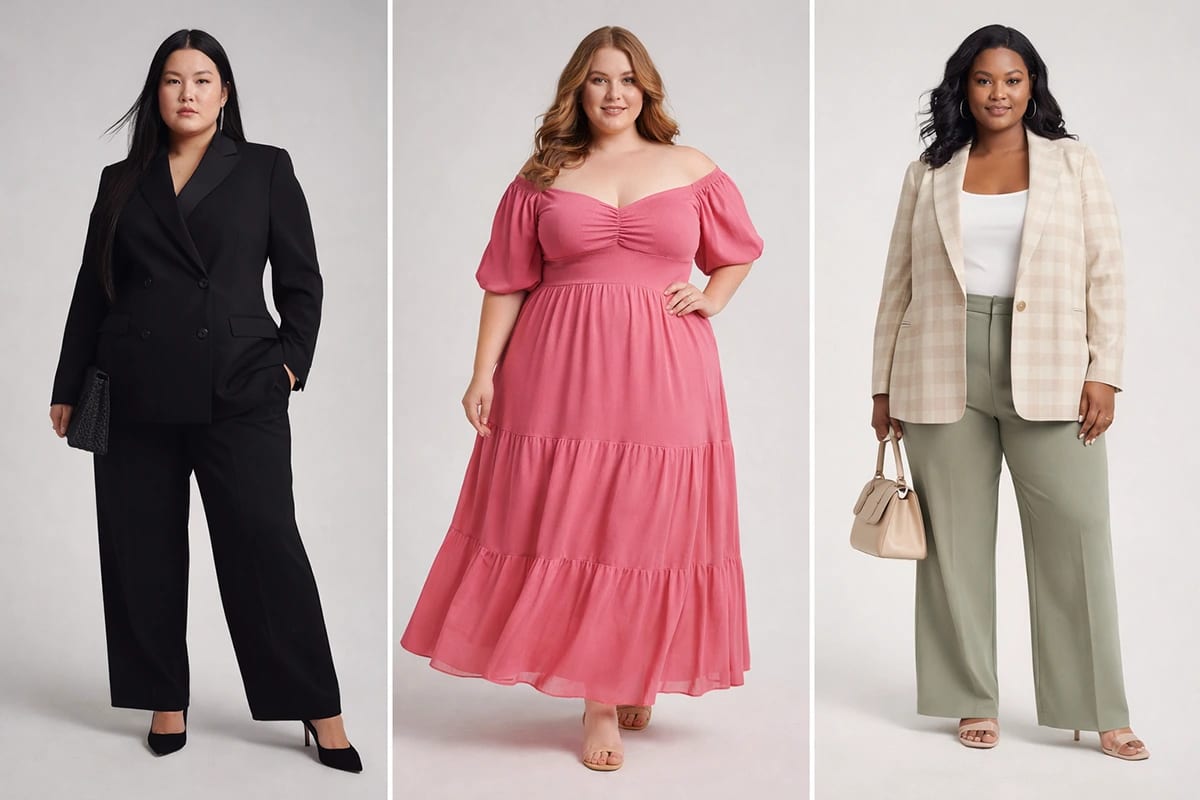 At every size, fit strategy follows line logic: vertical, width, balance, or curve.
The 7-Day Line Test: A Simple Reality Check
If you still feel unsure after reading guides, run this one-week experiment. It is one of the fastest ways to answer kibbe body type at any size in real life.
Day 1-2: Test Vertical
- Wear long, continuous lines with minimal breaks
- Keep color transitions smooth from top to bottom
- Use cleaner, sharper shapes
Track:
- Do you look more polished, or too severe?
- Do you feel balanced, or swallowed?
Day 3-4: Test Width and Relaxed Structure
- Wear outfits with shoulder room and controlled ease
- Use textured fabrics and less rigid tailoring
- Keep shapes open rather than tightly molded
Track:
- Do you look fresh and natural, or messy and heavy?
- Does the outfit look effortless or undefined?
Day 5-6: Test Curve and Soft Definition
- Use waist suggestion, drape, and rounded detail
- Keep fabrics fluid but not flimsy
- Choose silhouettes that follow body contour
Track:
- Do you look harmonious, or overdone?
- Does softness brighten you, or blur you?
Day 7: Review Photos Side by Side
Place all outfit photos in one folder and compare:
- Which line family gives you the clearest shape?
- Which line family gets the most unsolicited compliments?
- Which line family makes getting dressed easiest the next morning?
Your best answer usually appears quickly when you compare full looks, not isolated body parts.
If you want a faster shortlist before doing the test, start with:
 A one-week line test turns confusion into visible data you can trust.
Common Myths About Kibbe and Weight, Debunked
Myth 1: "Plus size means Romantic."
False. Plus size people can be any Image ID. Frame geometry, not body fat percentage, determines type.
Myth 2: "You cannot type yourself until you lose weight."
False. You can type at your current size by emphasizing structural clues and line testing.
Myth 3: "My weight gain pattern must match perfectly."
False. Gain patterns are trends, not rules. Use them as support, not as your first filter.
Myth 4: "Kibbe does not work for larger bodies."
False. The system is inherently size-inclusive because it is based on line harmony, not size labels.
Myth 5: "If I look different now, I must be a different type."
False. Visual expression can shift with weight. Underlying ID remains.
The faster you drop these myths, the faster your style decisions become practical and consistent.
Quick Do and Do Not Checklist
Do:
- Type from line behavior in clothing
- Use neutral photos for objectivity
- Compare neighboring types before finalizing
- Prioritize comfort plus visual harmony
Do not:
- Type from one body part
- Assume size label equals Image ID
- Copy celebrity outfits without line matching
- Retype yourself after every small weight change
If you follow this checklist, you will make fewer expensive shopping mistakes and build a wardrobe that works now, not someday.
FAQ
Does weight affect Kibbe body type? ▼
Can you be a Dramatic if you are plus size? ▼
Should I lose weight before typing myself? ▼
Why do I look like a different type after gaining weight? ▼
How should I use Kibbe weight gain patterns? ▼
Final Takeaway: Your Type Exists at Every Size
Your body type is not waiting at a smaller size. It is visible now, through your lines, your structure, and the way clothing responds to your frame.
If you want clarity, start with structure, test lines in real outfits, and verify with objective tools. That approach works whether you are straight-size, midsize, or plus size.
Next steps:
- Take the free Kibbe quiz to get your top candidates
- Browse all 13 Kibbe types to compare your likely matches
- Read the complete Kibbe body types guide for full context
- Use the comparison chart when you are split between two families