
How to Dress the Soft Classic Kibbe Body Type: Graceful Symmetry
Learn how to dress the Soft Classic Kibbe body type with practical outfit ideas, best fabrics, silhouettes, and styling rules that honor your balanced, soft lines.
If your reflection shows balanced symmetry with softly rounded edges, you may be a Soft Classic Kibbe Body Type.
In the Kibbe system, the Soft Classic is defined by balanced proportions paired with a soft yin influence. You possess the elegance of the Classic family, but with an added grace and softness that demands gentle definition. This guide will show you exactly how to dress the Soft Classic body type, with clear rules, fabric choices, and real outfit ideas that work in daily life.
Not sure if you’re a Soft Classic?
Take our free Kibbe body type quiz or read the full Soft Classic profile.
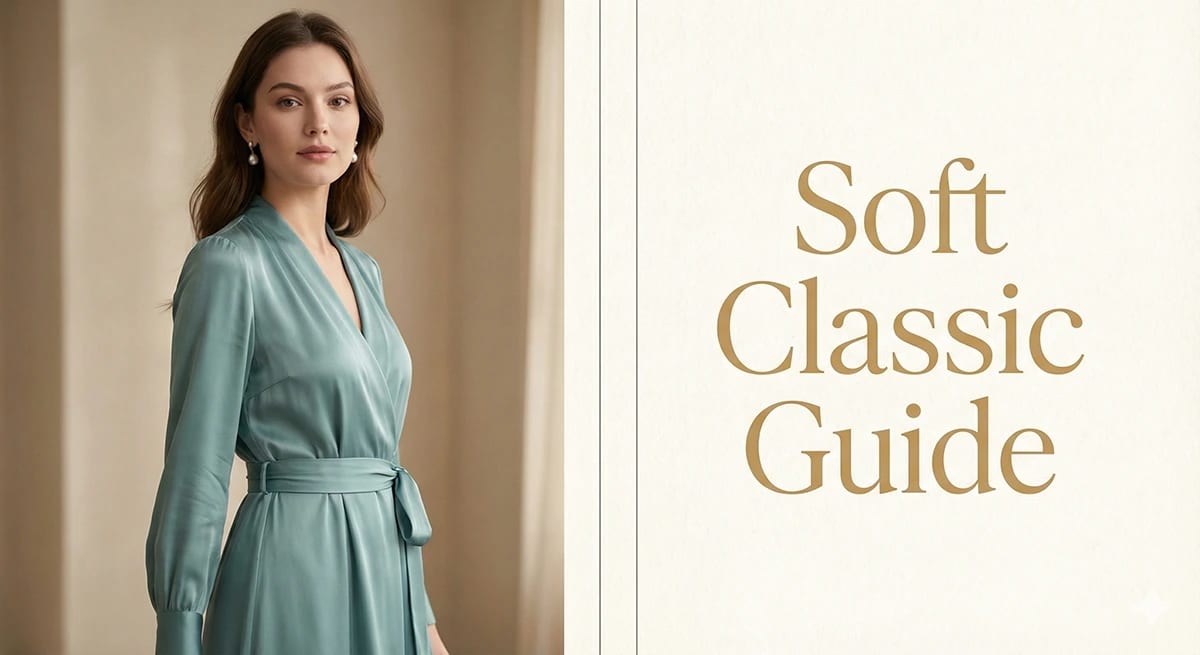
At a Glance: Soft Classic Styling Essentials
Here is your quick cheat sheet for mastering the Soft Classic look:
| Element | Best for Soft Classic | What to Avoid |
|---|---|---|
| Silhouette | Smooth, symmetrical, softly tailored | Boxy, unconstructed, or severely sharp |
| Lines | Clean, flowing, gently curved | Rigid, angular, or chaotic/broken lines |
| Fabrics | Lightweight, draping, matte or slight sheen | Stiff, heavy, rough, or bulky textures |
| Details | Refined, understated, waist-defining | Overly ornate, fussy, or excessively plain |
| Essence | Graceful, elegant, understated | Hard, edgy, or bohemian/unkept |
1. What Is the Soft Classic Body Type?
The Soft Classic is a specific variation of the Classic family. While the pure Classic is about perfect neutrality (50/50 Yin/Yang), the Soft Classic tips the scale slightly toward Yin.
Key Characteristics:
- Bone structure: Symmetrical and moderate, but with slightly tapered or sloped shoulders. Not sharp or angular.
- Body flesh: Soft and slightly rounded, particularly at the arms, thighs, and bust line. Evenly distributed weight.
- Vertical line: Moderate. You don't appear exceptionally tall or petite.
- Overall impression: Graceful, balanced, and refined. You look "softly constructed."
Crucially, your balance is your superpower. Unlike the Romantic (who is all curve) or the Dramatic (who is all sharp angles), you need to maintain that central sense of symmetry, just with the edges sanded down.
Note: If you feel balanced but sharp and dry, check the Dramatic Classic instead.
2. The Golden Rules of Soft Classic Styling
To dress a Soft Classic effectively, aim for Smooth Symmetry.
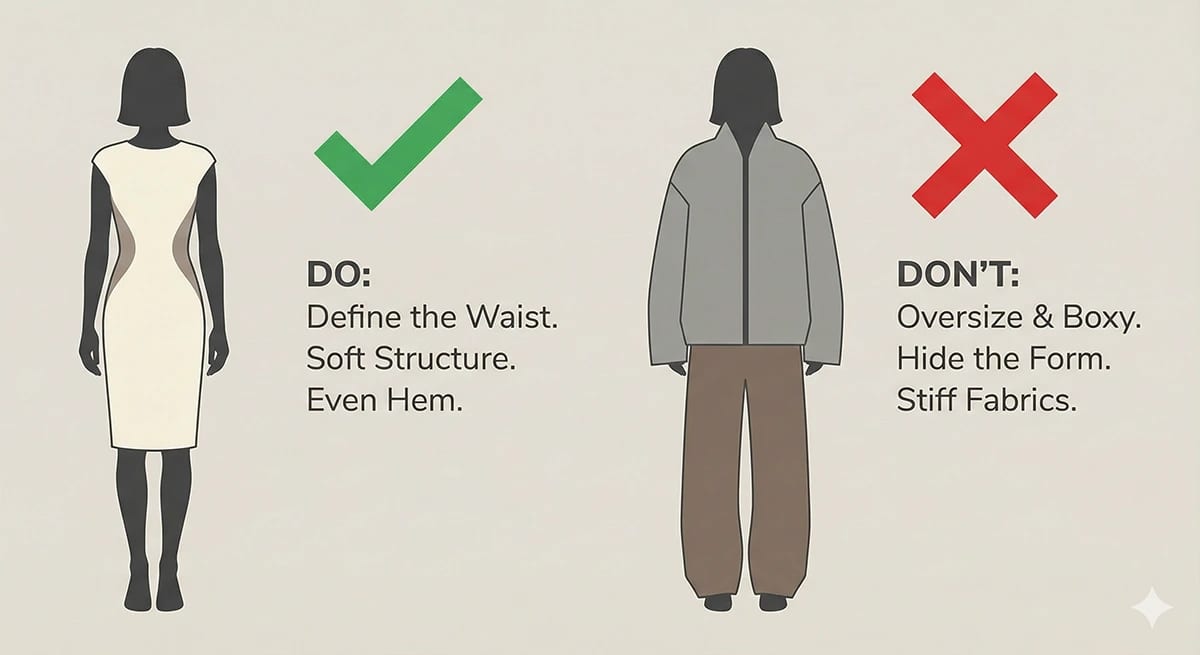
Rule #1: Soften the Edges
Structure is important, but it must never be rigid.
- Do: Choose tailored pieces that have curved edges (rounded collars, soft lapels).
- Don't: Wear severe, sharp tailoring or stiff military-style jackets.
Rule #2: Define the Waist Gently
Your soft yin flesh needs shaping, but not constriction.
- Do: Use soft belts, inset waistbands, or fluid fabrics that naturally skim the waist.
- Don't: Wear boxy, shapeless shifts or overly tight, corset-like cinching.
Rule #3: Conserve Symmetry
As a Classic, visual balance is key.
- Do: Keep hemlines even and details balanced on both sides of the outfit.
- Don't: Go for wild asymmetry, high-low hems, or one-shoulder distinct eccentricities.
Rule #4: Less Is More (Clean Lines)
Your elegance comes from simplicity.
- Do: Let the clean line of the silhouette speak for itself.
- Don't: Clutter your look with excessive ruffles, pockets, or heavy layering.
3. Best Fabrics for the Soft Classic
Fabric texture defines how the garment interacts with your soft curves. You need materials that glide, not hide.
- Best fabrics: Crepe, silk, challis, cashmere, soft linen, high-quality jersey, velvet.
- Textures that work: Smooth, matte, or slightly lustrous. Suede is excellent if soft.
- Fabrics to avoid: Stiff cottons, heavy wools, rough tweeds, bulky knits that hide your frame.
The Test: If you hold the fabric up and it stands stiffly on its own, it's likely too heavy. If it puddles softly, it’s perfect.
4. Item-by-Item Styling Guide
Tops & Blouses
Your tops should frame your face gently and define your torso without squeezing.
- Best Styles: Blouses with cowl necks, soft bow ties, or draped necklines. Crew necks and scoop necks are great if the fabric is soft.
- Fit: Semi-fitted. It should follow your outline.
- Avoid: Stiff button-downs, oversized t-shirts, plunging V-necks that are too sharp.
Skirts & Dresses
This is often the easiest category for Soft Classics. The goal is flow with definition.
- Dresses: Tea-length dresses, wrap dresses (in soft fabric), fit-and-flare styles with a gentle flare.
- Skirts: Soft pencil skirts, trumpet skirts, or tulip skirts. Hemlines should be around knee-length or mid-calf to maintain vertical balance.
- Avoid: Micro-minis, stiff A-lines, or giant voluminous ballgown skirts.
Pants & Jeans
Pants can be tricky because they are inherently more "yang/functional," but the right pair works wonders.
- Best Styles: Softly tailored trousers with a straight or slightly tapered leg. High-waisted styles help define the midsection.
- Fit: Clean and smooth.
- Avoid: Skinny jeans that are too tight, cargo pants with bulky pockets, or wide-leg styles that look baggy.
Jackets & Outerwear
Your jacket finishes the symmetry.
- Best Styles: Hip-length blazers with shawl collars, belted trench coats (soft fabric), cardigans that function as jackets.
- Details: Tapered sleeves and minimal buttons.
- Avoid: Boxy oversized coats, stiff leather biker jackets with heavy hardware.
5. Soft Classic Capsule Wardrobe: 10 Essential Pieces
Build a versatile, graceful wardrobe with these Soft Classic essentials. Each piece supports your need for symmetry while honoring your soft edges.
Foundation Pieces:
- Soft-structure blazer (collarless or shawl collar)
- Waist-defining tea dress (silk or soft crepe)
- Tapered trousers (lightweight wool or crepe)
- Straight-leg jeans (clean, medium wash)
- Draped silk blouse (cowl neck or soft bow)
- Fine-knit cashmere sweater (crew or boat neck)
Outerwear & Shoes:
- Soft trench coat (belted, fluid fabric)
- Rounded-toe leather pumps (nude or matching tone)
- Sleek ballet flats ( almond toe)
- Soft leather handbag (structured but not rigid)
6. Soft Classic Kibbe Outfit Ideas
Here are three complete looks to help you visualize the principles.
Look 1: Refined Casual
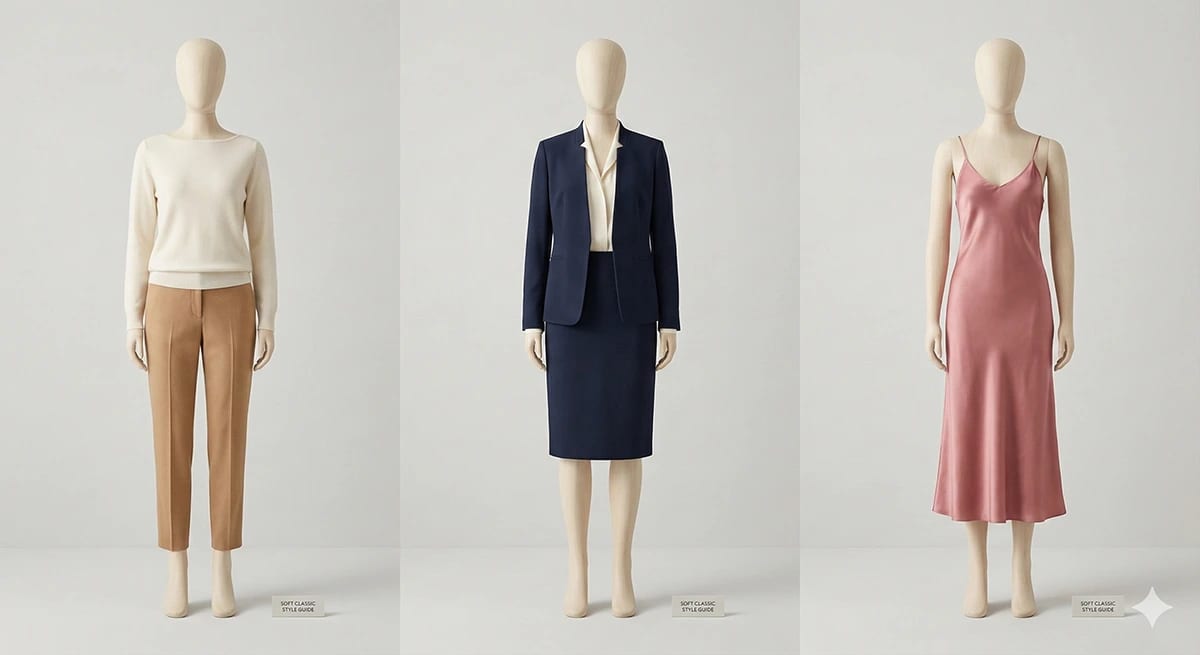
- The Top: A cashmere boat-neck sweater in a soft pastel or neutral tone.
- The Bottom: High-waisted, tapered trousers in a soft crepe fabric.
- The Shoes: Simple leather ballet flats or loafers with a rounded toe.
- Why it works: It’s comfortable but respects the need for clean lines and tactile softness.
Look 2: Soft Polished Workwear
- The Top: A silk blouse with a subtle sheer overlay or gentle pussy-bow neck.
- The Jacket: A collarless, soft-structure blazer that hits at the hip.
- The Bottom: A knee-length skirt with gentle pleating.
- Why it works: It commands respect through symmetry and quality without needing "power suit" stiffness.
Look 3: Evening Grace
- The Dress: A midi-length satin slip dress (bias cut) or a velvet wrap dress.
- The Accessories: Pearl drop earrings and a symmetrical clutch.
- Why it works: The bias cut naturally honors the curves while maintaining a long, unbroken vertical line.
7. Accessories, Hair & Makeup for the Soft Classic
Jewelry
- Style: Rounded, symmetrical, and moderate sized.
- Materials: Pearls, rose gold, vintage settings.
- Avoid: Sharp geometric earrings, chunky aesthetic plastic, or tiny delicate chains that vanish.
Hair
- Goal: Controlled softness. The hair should frame the face gently.
- Styles: Soft waves, a smooth bob with curved ends, or a neat low bun with a few loose tendrils.
- Avoid: Severe slicked-back ponies, wild unkempt layers, or sharp asymmetrical cuts.
Makeup
- Goal: Watercolor blending.
- Application: Blended blush, soft berry or rose lips, slightly shimmery eyes.
- Avoid: Harsh contours, graphic eyeliner, or heavy matte foundations.
FAQ: Soft Classic Kibbe Body Type Styling Questions
Can a Soft Classic wear prints? ▼
What if I am overweight? Am I still Soft Classic? ▼
Can I wear sneakers? ▼
How do I know if I'm Soft Classic or Soft Natural? ▼
Embracing Your Soft Classic Lines
The Soft Classic beauty is arguably the most timeless of all. It is the "Grace Kelly" essence—flawless, composed, and effortlessly feminine. By respecting your need for symmetry and softness, you avoid the trap of looking frumpy (too loose) or severe (too stiff).
Your style journey is about refinement. Let your natural balance shine through, and you will always look perfectly dressed.
Next steps:
- Explore the full Soft Classic style guide
- Compare Soft Classic vs Dramatic Classic
- Take the Kibbe body type quiz if you're still unsure