
Is Kibbe Body Typing Scientific? The Truth Behind the System
Is Kibbe body typing scientific? Explore the evidence, psychology, and real-world value of this popular style framework to decide if it works for you.
If you have explored the world of Kibbe body types, you have probably wondered: is Kibbe body typing scientific? It is a fair question. With 13 distinct image identities, complex terminology, and detailed style recommendations, Kibbe feels systematic—but does that make it science?
The short answer is no. The Kibbe system is not science in the traditional, empirical sense. There are no peer-reviewed studies, controlled experiments, or laboratory validation behind it. But this does not mean the system lacks value or logic.
In this article, we will explore what the Kibbe system actually is, why it is not science (and was never meant to be), and whether it can still be useful for your personal style journey. If you are curious about your own type, our Kibbe Body Type Quiz provides a structured starting point—no lab coat required.
Let's separate fact from fiction.

What "Scientific" Actually Means
Before we can answer is Kibbe scientific, we need to define what science actually is.
In the strictest sense, a scientific theory or system must:
- Be testable and falsifiable — You can design experiments to prove or disprove it.
- Have empirical evidence — Claims are supported by data from controlled studies.
- Be reproducible — Other researchers can replicate the results independently.
- Undergo peer review — Experts evaluate the methodology and findings.
Does Kibbe body typing meet these criteria? No. There are no published studies testing whether Dramatic types genuinely look better in sharp, elongated lines, or whether Romantics objectively suit soft, draped fabrics. The claims are based on observation and aesthetic theory, not controlled experiments.
This does not make Kibbe wrong—it simply means it operates in a different domain than empirical science.
The Origins of the Kibbe System
To understand why Kibbe body typing is not scientific, it helps to know its origins.
David Kibbe developed his system in the 1980s, publishing it in his book Metamorphosis (1987). Kibbe was not a scientist—he was an image consultant and stylist with a background in theater and fashion. His framework grew from years of client consultations, not laboratory research.
The Yin-Yang Foundation
Kibbe borrowed the Yin-Yang concept from Eastern philosophy:
| Quality | Yang (Sharp) | Yin (Soft) |
|---|---|---|
| Lines | Angular, straight, elongated | Curved, rounded, delicate |
| Bones | Sharp, narrow, prominent | Small, rounded, soft |
| Flesh | Taut, lean, muscular | Soft, lush, full |
| Overall | Dramatic, striking | Romantic, gentle |
Every person has a blend of these characteristics. Kibbe's 13 types represent different balance points along this spectrum.
This is not science—it is an aesthetic framework rooted in design principles. Designers, artists, and stylists have used concepts like balance, proportion, and visual harmony for centuries. Kibbe simply applied these ideas to personal style.
For a visual overview of all types, see our Kibbe Body Types Chart.
Why Kibbe Is Not Science (And Never Claimed to Be)
Let's be clear: is Kibbe body typing scientific? No—and David Kibbe himself has never claimed otherwise.
1. No Empirical Research Exists
There are no peer-reviewed studies testing the Kibbe system. No researchers have measured whether certain silhouettes objectively flatter certain bone structures. The system is based on qualitative observation, not quantitative data.
2. The Terminology Is Subjective
Kibbe terms like "vertical," "width," and "curve" have specific meanings within the system—but they are interpreted visually, not measured precisely.
For example:
- Vertical line refers to how tall you appear, not your actual height in inches.
- Width refers to horizontal bone structure, not body fat or weight.
Two trained stylists might assess the same person differently. This subjectivity is inherent in aesthetic evaluation—and fundamentally different from scientific measurement.
3. It Operates in the Realm of Aesthetics
Art, design, fashion, and music are not science—but they are not random either. They follow principles of balance, harmony, contrast, and proportion. The Kibbe system applies these aesthetic principles to the human body and clothing.
This is similar to:
- Color theory in visual art
- Musical harmony in composition
- Interior design principles
These fields have internal logic and practical value without being "scientific" in the empirical sense.
Is Kibbe Body Typing Pseudoscience?
Some critics label Kibbe as pseudoscience—but this accusation misunderstands what pseudoscience actually is.
What Is Pseudoscience?
Pseudoscience refers to claims that pretend to be scientific but are not. Examples include:
- Astrology claiming to predict personality based on birth dates
- Phrenology claiming skull shapes reveal intelligence
- Historical somatotype theory (ectomorph, mesomorph, endomorph) claiming body shape determines personality
These systems made scientific-sounding claims that were later debunked by actual research.
Why Kibbe Is Not Pseudoscience
Kibbe has never claimed to be science. It is explicitly a style framework—a tool for creating visual harmony between your body and clothing. It does not make claims about personality, health, intelligence, or anything outside the scope of personal styling.
Calling Kibbe "pseudoscience" is like calling interior design pseudoscience because there are no studies proving that matching curtains to carpet "works." It misunderstands the nature of aesthetic practices.
A more accurate description: Kibbe is a styling methodology—similar to seasonal color analysis, capsule wardrobe theory, or minimalist fashion principles. Useful, structured, but not empirically validated.
The Science That Is Related to Kibbe
While Kibbe itself is not scientific, some related concepts have research backing.
1. Visual Perception and Psychology
Research in visual perception shows that humans naturally respond to:
- Balance and symmetry — We find balanced compositions visually pleasing.
- Proportion and scale — Certain proportions (like the golden ratio) appear in art across cultures.
- Color harmony — Some color combinations are perceived as more pleasing than others.
Kibbe applies these principles intuitively, even if no study directly validates its specific type assignments.
2. The Psychology of Clothing
Academic research confirms that clothing affects:
- First impressions — People form rapid judgments based on appearance.
- Self-perception — What you wear influences how you feel about yourself.
- Social outcomes — Appropriate dressing impacts professional and social success.
While no study proves "Dramatics should wear sharp lines," research does support the broader idea that what you wear matters for perception and confidence.
3. Body Dysmorphia and Self-Perception
One challenge with self-typing is body dysmorphia—the tendency to misperceive your own body. Research shows most people lack objectivity about their appearance, which is why structured tools like a quiz or second opinions can improve accuracy.
Comparing Kibbe to Other Body Typing Systems
How does Kibbe's evidence basis compare to other popular systems?
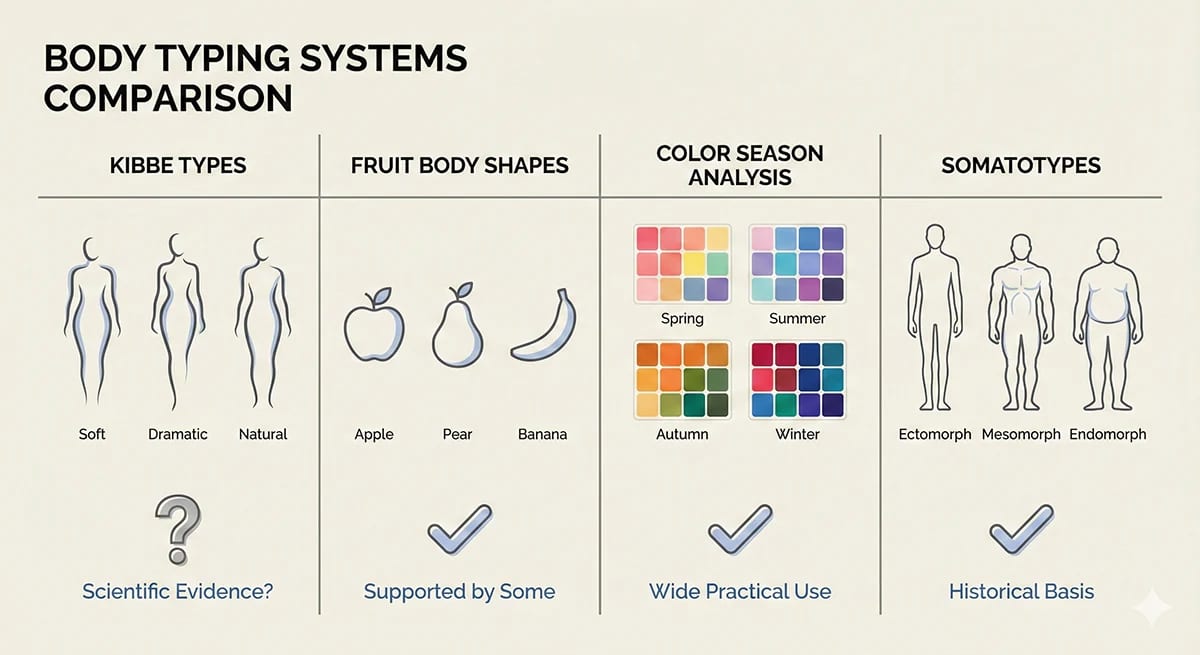
Fruit Body Shapes (Apple, Pear, Hourglass)
These categories are based on bust-waist-hip ratios—measurable, objective numbers. But no research proves that dressing to "balance" these ratios actually looks better. It is equally aesthetic and unvalidated.
Somatotypes (Ectomorph, Mesomorph, Endomorph)
Originally developed in the 1940s, somatotype theory claimed body shape correlated with personality traits. Modern research has thoroughly debunked these claims. The categories are now considered outdated and unscientific.
Color Season Analysis
Like Kibbe, color analysis (Spring, Summer, Autumn, Winter) is based on observation and theory, not controlled studies. It is widely used in fashion despite lacking empirical validation.
The Takeaway
No mainstream body typing system has strong scientific support. If you reject Kibbe for lacking evidence, you should also reject fruit shapes, color seasons, and most other fashion frameworks. The question is not "is it scientific?" but "is it useful?"
Tips for Using Kibbe Without Scientific Proof
If Kibbe body typing is not scientific, how should you approach it? Here are practical tips:
1. Treat It as a Framework, Not a Rulebook
The goal is not to follow Kibbe rules rigidly—it is to use the system as a starting point for experimentation. If a recommendation does not work for you, adjust it. Your mirror is the final judge.
2. Validate Through Experience
The true test of any style system is: do the recommended clothes look and feel right? Try outfits in your suggested type's lines. Keep what works, discard what does not. This pragmatic approach sidesteps the need for scientific proof.
3. Use Structured Tools
A well-designed assessment tool can reduce the subjectivity problem. Our Kibbe Body Type Quiz guides you through concrete questions, helping you evaluate features more objectively than intuition alone.
4. Seek External Perspectives
Since self-perception is often biased, ask trusted friends or stylists for input. They may notice features you overlook or misperceive.
5. Keep an Open Mind
You may need to explore multiple types before finding the best fit. This is normal—even non-scientific frameworks require trial and adjustment.

Related Resources on This Site
If you want to explore Kibbe further—science or not—these resources can help:
- Take the Free Kibbe Body Type Quiz — Get a structured assessment based on your physical features. The quiz breaks abstract concepts into concrete questions, providing a personalized starting point.
- Kibbe Body Types Chart — View all 13 types side-by-side to understand how they differ. This visual reference is helpful for comparing possibilities.
- Is Kibbe Body Typing Accurate? — Explore the reliability and limitations of Kibbe assessments in more detail.
Common Questions About Kibbe and Science
Is Kibbe body typing based on science? ▼
Does Kibbe have any scientific evidence? ▼
Is Kibbe body typing pseudoscience? ▼
Why do people use Kibbe if it's not scientific? ▼
Can Kibbe body typing still be accurate without scientific proof? ▼
Are other body typing systems more scientific than Kibbe? ▼
Conclusion: Science Is Not the Only Measure of Value
So, is Kibbe body typing scientific? No—and it does not need to be.
The Kibbe system is a styling framework, not a scientific theory. It is based on aesthetic principles, visual observation, and decades of practitioner experience. There are no lab studies proving it works—but there are countless users who have found clarity and confidence through its guidance.
Science is not the only source of useful knowledge. Art, music, design, and fashion all operate on principles that are studied, taught, and applied successfully—without controlled experiments validating every claim.
The real question is not whether Kibbe is scientific, but whether it helps you:
- Do the recommendations make sense for your body?
- Do you feel more confident in suggested styles?
- Has the framework reduced confusion about what to wear?
If yes, the system has value for you—regardless of its scientific status.
Ready to explore whether Kibbe works for you?
- Take the Free Kibbe Body Type Quiz — Get your personalized result and see if the recommendations resonate.
- View the Kibbe Body Types Chart — Compare all 13 types to understand the spectrum.
- Learn More About Kibbe Accuracy — Understand the reliability and practical value of typing.
The best style system is the one that helps you dress with confidence. Science or not, that is what ultimately matters.