
Is Kibbe Body Typing Accurate? What You Need to Know
Wondering if Kibbe body typing is accurate? Learn how the system works, its strengths and limitations, and whether it's the right framework for your personal style.
If you have ever read through Kibbe body type descriptions and thought, "This sounds right… but is it actually accurate?" you are not alone. The Kibbe system is widely discussed in style communities, praised by some and questioned by others. With its unique terminology and subjective assessment process, many people wonder: is Kibbe body typing accurate?
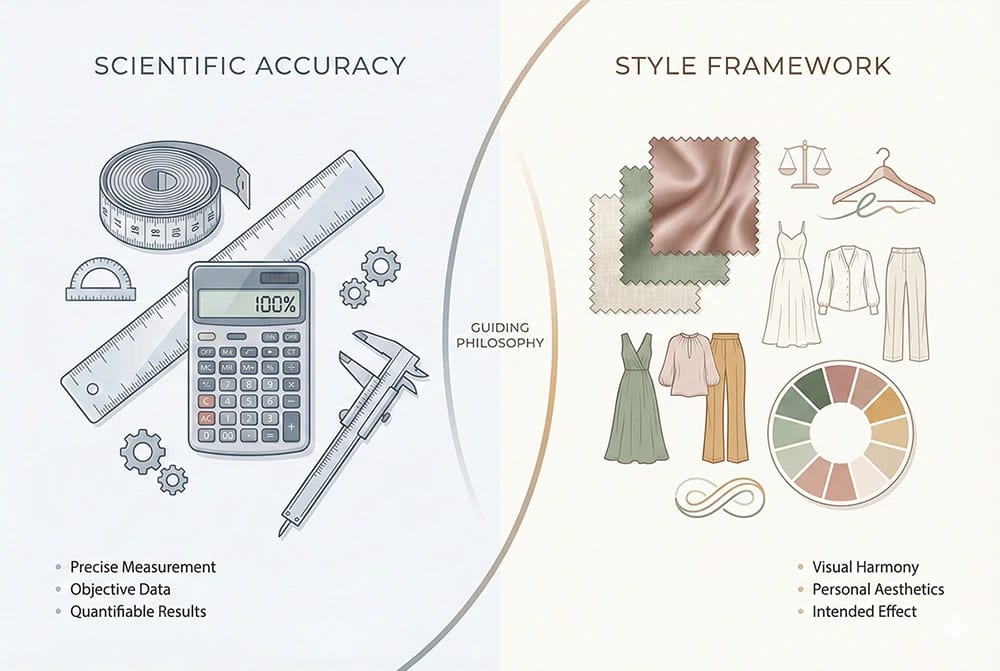
The short answer is: it depends on how you define "accurate." Unlike scientific measurements, the Kibbe system is a style framework designed to help you understand visual harmony between your body and clothing. It is not perfect, and it is not science—but it can be incredibly useful when applied correctly.
If you are curious about whether Kibbe is worth your time, or if you want to understand its limitations before committing to the process, this guide will give you a balanced, honest look at the system's strengths, weaknesses, and practical value. And if you decide to explore further, our Kibbe Body Type Quiz offers a structured starting point.
Let's dig into what makes Kibbe accurate—and where it falls short.
What Does "Accurate" Mean in Body Typing?
Before we can answer is Kibbe accurate, we need to clarify what we mean by "accurate."
In scientific terms, accuracy refers to how close a measurement or prediction is to the true value. But Kibbe body typing is not a measurement system—it is a classification framework based on visual perception and style principles.
Think of it this way:
- Scientifically accurate: Your height is 5'6" (measurable, objective, verifiable).
- Style framework accurate: You have a "moderate vertical line" (subjective, based on overall impression).
The Kibbe system does not claim to be scientifically precise. Instead, it aims to identify which clothing silhouettes will harmonize with your natural lines. In this context, "accuracy" means: does the system help you identify styles that look and feel right on your body?
For many people, the answer is yes—but only if they understand how to use the system correctly.
How the Kibbe Body Typing System Works
To evaluate whether Kibbe body typing is accurate, we first need to understand how it works.
The Core Principles
Created by David Kibbe in the 1980s, this system is based on the concept of Yin and Yang balance:
- Yang traits: Sharp, angular, elongated, narrow
- Yin traits: Soft, rounded, delicate, lush
Every person has a mix of these characteristics. The Kibbe system categorizes people into 13 Image Identities (IDs) based on their dominant traits:
| Family | Primary Characteristic | Examples |
|---|---|---|
| Dramatic | Pure Yang (sharp, long, narrow) | Long vertical line, angular bones |
| Natural | Soft Yang (blunt, broad, relaxed) | Athletic build, width in shoulders |
| Classic | Balanced Yin/Yang | Moderate proportions, symmetrical |
| Romantic | Pure Yin (soft, rounded, lush) | Curved lines, delicate bones |
| Gamine | Yin + Yang contrast | Petite frame with mixed features |
Within these families are subtypes like Soft Dramatic, Flamboyant Natural, or Soft Classic, accounting for variations.
For a visual breakdown of all types, visit our Kibbe Body Types Chart.
The Assessment Process
Kibbe typing involves evaluating three main areas:
- Bone structure: Are your bones sharp and angular, or rounded and delicate?
- Body flesh: Is your flesh muscular, soft, or moderate?
- Vertical line: Do you appear tall and elongated, moderate, or compact?
The challenge? These assessments are subjective. What one person sees as "sharp," another might see as "blunt." This subjectivity is where accuracy issues often arise.
The Strengths of the Kibbe System
Despite its limitations, the Kibbe system has several real strengths that explain its enduring popularity.
1. It Focuses on Overall Harmony, Not Measurements
Unlike traditional body shape systems (pear, apple, hourglass), Kibbe does not rely on bust-waist-hip ratios. This makes it more flexible and applicable across different weights, ages, and sizes.
Your bone structure does not change when you gain or lose weight. A Dramatic remains a Dramatic, and a Romantic remains a Romantic. The system adapts to you, not the other way around.
2. It Provides a Consistent Style Framework
Once you identify your type, you get clear, actionable guidance on:
- Which silhouettes flatter your natural lines
- Which fabrics work best with your body
- Which details (necklines, waistlines, hemlines) to prioritize or avoid
This consistency is valuable for building a cohesive wardrobe. Instead of trying random trends, you have a personalized roadmap.
3. It Encourages Self-Acceptance
The Kibbe philosophy emphasizes working with your body, not against it. There is no "ideal" type—each has its own beauty and strengths. This body-positive approach resonates with many users who are tired of one-size-fits-all beauty standards.
4. It Has a Strong Community
Decades of user experimentation have refined the system. Online communities share real-world feedback, celebrity examples, and styling tips, making it easier to learn and apply Kibbe principles.

The Limitations and Criticisms of Kibbe Body Typing
Now let's address the elephant in the room: is Kibbe body typing accurate in its assessments? Here are the most common criticisms and limitations.
1. The Terminology Is Subjective and Abstract
Words like "vertical," "width," "curve," and "petite" have very specific meanings in Kibbe—but they are not intuitive. Without proper guidance, beginners often misinterpret these terms and mistype themselves.
For example:
- "Width" in Kibbe does not mean being heavy. It refers to horizontal bone structure (broad shoulders, blunt bones).
- "Vertical line" is not just about height—it is about how tall you appear overall.
This abstraction leads to confusion and frustration, especially for self-typers.
2. Self-Assessment Is Difficult
Most people lack objectivity about their own appearance. We focus on perceived flaws, overlook key features, and struggle to see ourselves as others do. This makes self-typing prone to error.
A structured quiz can help by breaking down abstract concepts into concrete questions, but even quizzes require honest, objective answers.
3. Celebrity Examples Can Be Misleading
Kibbe and his followers often use celebrities as type examples. But celebrities are styled, lit, and photographed professionally. What you see in a red carpet photo may not reflect their natural lines in everyday clothing.
Additionally, celebrity typings are often disputed within the community, adding to the confusion.
4. The System Has Outdated Elements
Kibbe developed this system in the 1980s, and some aspects feel dated:
- Certain style recommendations (like "Romantics should always wear ruffles") are too rigid for modern tastes.
- The original book focused heavily on cisgender women, though the principles can apply to anyone.
Modern interpretations have updated the system, but inconsistencies remain.
5. It Lacks Scientific Validation
The Kibbe system is not based on empirical research. There are no peer-reviewed studies proving that certain clothing lines objectively "suit" certain body types. It is based on Kibbe's personal observations and style philosophy.
This does not make it useless—many art forms lack scientific backing—but it does mean you should treat it as a flexible guide, not an absolute truth.
When Kibbe Body Typing Works Best
So, when is Kibbe body typing accurate and useful? Here are the ideal conditions:
1. You Approach It as a Framework, Not a Rulebook
Kibbe works best when you treat it as a starting point for experimentation, not a strict set of rules. If a recommended silhouette feels wrong, adjust it. The goal is harmony, not rigidity.
2. You Use Structured Tools for Assessment
A well-designed quiz (like our Kibbe Body Type Quiz) can guide you through the assessment process objectively. It reduces subjective bias and helps you focus on the right features.
3. You Validate Your Type Through Real-World Testing
The true test of accuracy is: do the recommended clothes look and feel right? Try on outfits in your suggested type's lines. If they work, you have found your match. If not, you may need to reassess.
4. You Understand the System's Language
Take time to learn what Kibbe terminology actually means. Read resources, study examples, and compare different types side-by-side. The more you understand the framework, the more accurately you can apply it.
Tips for Getting Accurate Kibbe Results
If you want the most accurate possible Kibbe typing, follow these best practices:
1. Be Honest and Objective
When answering quiz questions or self-assessing, avoid wishful thinking. Focus on what is, not what you wish were true. If possible, ask a trusted friend for input—they may see features you overlook.
2. Use Full-Length Photos in Neutral Clothing
Stand in front of a mirror or take photos in form-fitting, neutral-colored clothing. Avoid busy patterns, oversized garments, or heavy makeup that might distort your natural lines.
3. Focus on Bone Structure First
Your skeleton does not lie. Start by assessing your bones (shoulders, jaw, hands, feet) before considering flesh or weight. Bone structure is the foundation of your type.
4. Test Multiple Types if Uncertain
If your quiz result does not feel quite right, explore similar types. For example, if you are torn between Soft Natural and Flamboyant Natural, try clothing recommendations for both and see which resonates.
5. Do not Rush the Process
Finding your type is not a race. It is okay to spend weeks or months exploring, experimenting, and refining your understanding. The more patient you are, the more accurate your result will be.

Related Resources on This Site
If you are exploring whether Kibbe body typing is accurate for you, these resources can help you make an informed decision:
- Take the Free Kibbe Body Type Quiz — Get a structured, objective assessment in minutes. This quiz breaks down abstract concepts into clear questions and provides a personalized result hypothesis.
- Kibbe Body Types Chart — View all 13 types side-by-side to understand the differences at a glance. This visual reference is helpful for comparing types and validating your result.
- How to Determine Your Kibbe Body Type — A detailed guide on the assessment process, including tips for avoiding common pitfalls and improving accuracy.
Common Questions About Kibbe Body Typing Accuracy
Is Kibbe body typing scientifically accurate? ▼
Can Kibbe body typing be wrong? ▼
Does Kibbe work for all body sizes? ▼
Why do people criticize the Kibbe system? ▼
Is taking a Kibbe quiz accurate? ▼
What makes Kibbe different from other body typing systems? ▼
So, is Kibbe body typing accurate?
It is accurate as a style framework, not as a scientific classification system. Its value depends on how objectively it is applied and validated through real clothing choices.
Conclusion: Is Kibbe Body Typing Worth Your Time?
So, is Kibbe body typing accurate? The answer is nuanced.
Kibbe is not scientifically validated, and it is prone to mistyping if you do not understand the system or lack objectivity. But for many people, it is an incredibly valuable tool for understanding which clothing silhouettes harmonize with their natural lines.
The key is to approach it with the right expectations:
- Treat it as a framework, not a rigid set of rules.
- Use structured tools (like a quiz) to improve objectivity.
- Validate your type by testing real-world clothing recommendations.
- Be patient and willing to refine your understanding over time.
If you are curious about your Kibbe type and want a clear starting point, our quiz can help you navigate the system with less confusion and more clarity.
Ready to explore whether Kibbe works for you?
- Take the Free Kibbe Body Type Quiz — Get your personalized result and actionable style guidance.
- View the Kibbe Body Types Chart — Compare all 13 types visually to understand the system's structure.
- Learn How to Determine Your Type — Deep-dive into assessment techniques and accuracy tips.
Remember: the most "accurate" body typing system is the one that helps you feel confident and authentic. Whether Kibbe is that system for you is something only you can decide—and trying it is the first step.