
Romantic vs Theatrical Romantic: Key Differences Explained
Confused between Romantic and Theatrical Romantic body types? Learn the subtle differences in Yin/Yang balance, facial features, and styling to identify your true Kibbe type.
If you've been exploring the Kibbe Body Type system, you might find yourself torn between Romantic and Theatrical Romantic. This confusion is completely normal—these two types are neighbors on the Kibbe spectrum and share many similarities. Both are characterized by soft, curved features and a predominantly Yin essence. However, the subtle differences between them can significantly impact your most flattering styling choices.
Understanding the distinction between romantic vs theatrical romantic is essential for finding clothes that truly enhance your natural beauty. While both types celebrate feminine curves, Theatrical Romantic has a touch of Yang sharpness that sets it apart from the pure, rounded softness of Romantic. In this guide, we'll break down the key differences in bone structure, facial features, body flesh, and styling to help you determine which type resonates with you. If you're still unsure after reading this article, our Romantic body type page and comparison chart can provide additional clarity.
Let's explore what makes each type unique and how to tell them apart with confidence.
Understanding the Romantic and Theatrical Romantic Types
The Kibbe Body Type system, developed by David Kibbe in the 1980s, categorizes bodies based on their balance of Yin (soft, rounded, delicate) and Yang (sharp, angular, strong) characteristics. Among the 13 body types, Romantic and Theatrical Romantic sit on the Yin-dominant end of the spectrum.
Romantic represents pure Yin with minimal Yang influence. Think of classic Hollywood icons like Marilyn Monroe or modern celebrities like Emilia Clarke. The Romantic body type is characterized by:
- Soft, rounded bone structure with small, delicate bones
- Lush, full body flesh throughout
- Rounded facial features with full cheeks and soft jawlines
- An overall impression of luxurious femininity and sensuality
Theatrical Romantic, on the other hand, is primarily Yin with a subtle Yang undercurrent. This type was personified by icons like Vivien Leigh and can be seen today in celebrities such as Salma Hayek or Mila Kunis. Theatrical Romantic features include:
- Delicate bone structure with slight sharpness (narrow shoulders, small hands/feet)
- Soft flesh with some definition and slight musculature
- Facial features that mix softness with subtle angles (e.g., full lips but sharper nose or cheekbones)
- A compact, hourglass silhouette with visible waist definition
Both types are petite to moderate in height (typically 5'5" and under, though height is not an absolute rule), but the key difference lies in that hint of Yang sharpness in Theatrical Romantic that creates a more "etched" or defined appearance compared to Romantic's all-over softness.
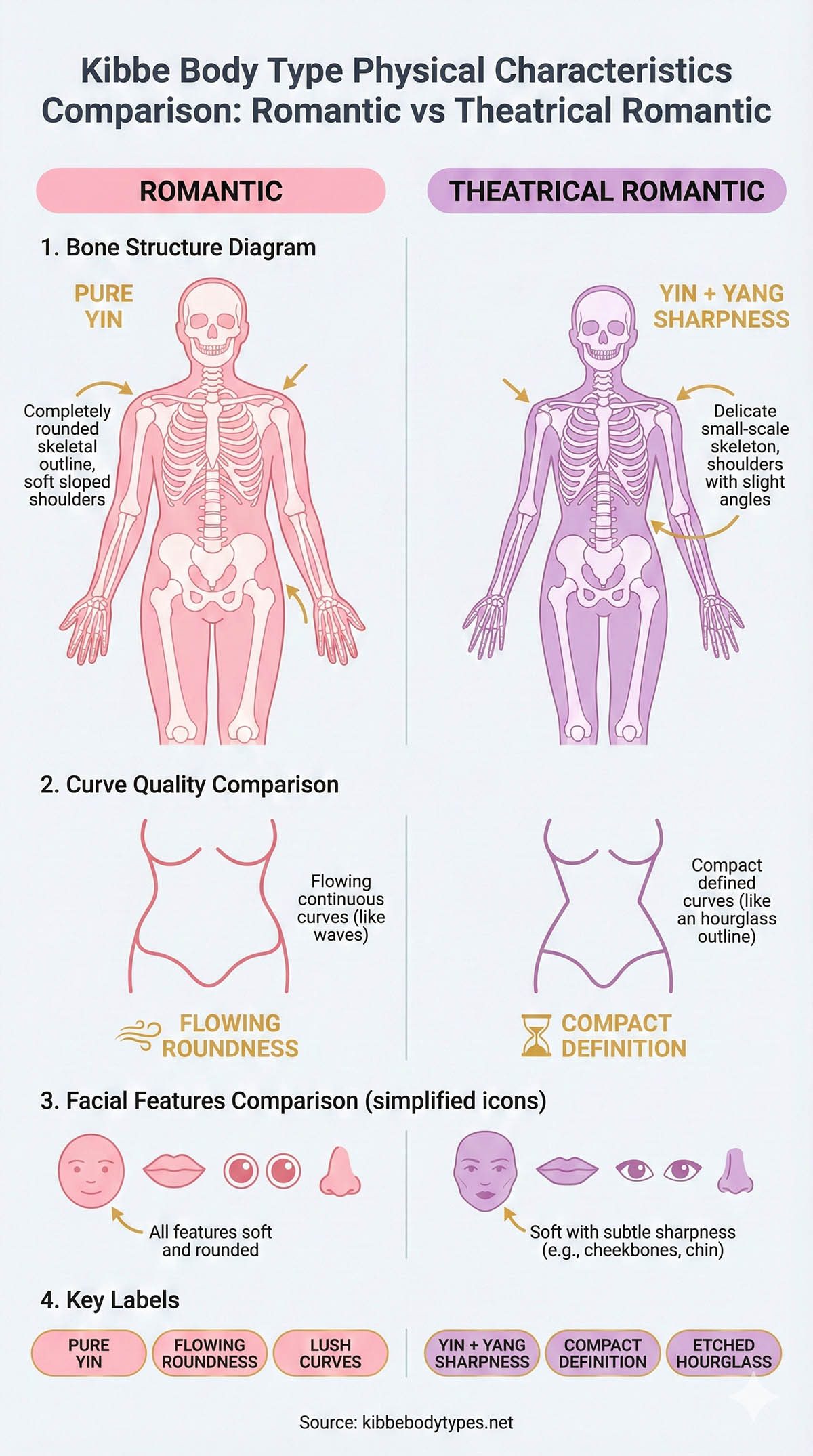 Visual comparison: Romantic (pure Yin softness) vs Theatrical Romantic (Yin with Yang sharpness)
Romantic vs Theatrical Romantic: Physical Characteristics
Understanding the physical differences between these types is crucial for accurate identification. Let's break down the characteristics systematically:
Bone Structure
Romantic:
- Small, delicate bones that appear rounded
- Sloped shoulders with soft, rounded edges
- Short arms and legs in proportion to torso
- Small hands and feet with soft, fleshy appearance
- Overall impression: soft, flowing lines with no visible angularity
Theatrical Romantic:
- Small, delicate bones with slight sharpness
- Narrow, sometimes slightly angular shoulders
- Limbs may appear more defined, with visible wrist or ankle bones
- Small, narrow hands and feet with some angularity
- Overall impression: delicate with hints of sharpness or definition
Body Flesh and Weight Distribution
Romantic:
- Soft, lush flesh throughout the body
- Weight gain tends to be evenly distributed, maintaining roundness
- Curves are rounded and continuous
- Arms and legs remain soft even when toned
- Muscle definition is minimal even with exercise
Theatrical Romantic:
- Soft flesh with slight firmness or definition
- Weight gain may first appear in the waist and hips, but definition remains
- Curves are compact and shapely with visible waist indentation
- Arms and legs may show more muscle tone
- Can achieve and maintain more visible definition than Romantic
Facial Features
Romantic:
- Round or softly oval face shape
- Full, rounded cheeks
- Soft, full lips
- Large, round eyes
- Small, rounded nose
- Soft, gently rounded jawline and chin
- Overall impression: completely soft and lush
Theatrical Romantic:
- Oval face with some delicate tapering
- Full cheeks but with slight facial definition
- Full lips (may have a defined Cupid's bow)
- Large, expressive eyes (may have slight almond shape)
- Nose may be small and slightly sharper or more defined
- Jawline has soft definition rather than complete roundness
- Overall impression: soft with subtle sculpting
These differences may seem subtle on paper, but they're important for determining which clothing lines will harmonize best with your natural features.
How to Tell the Difference: A Practical Approach
Distinguishing between romantic vs theatrical romantic kibbe types can be challenging because the differences are nuanced. Here's a step-by-step approach to help you identify your type:
Step 1: Assess Your Overall Impression
Stand in front of a mirror in form-fitting clothing or underwear. What's your first impression?
- Romantic: Soft, rounded, lush—like a ripe peach
- Theatrical Romantic: Defined, compact curves—like a delicate hourglass
Step 2: Check for Yang Elements
Look for any sharp, angular, or defined features:
- Examine your shoulders: Are they purely rounded or do they have any narrowness or angularity?
- Look at your hands and feet: Are they completely soft and fleshy, or do you see bone definition?
- Check your facial features: Is every feature soft and rounded, or do you notice any sharpness (pointed chin, defined cheekbones, sharper nose)?
If you find NO Yang elements, you're likely Romantic. If you notice subtle sharp or defined elements, you're likely Theatrical Romantic.
Step 3: Observe Your Curves
Both types are curvy, but the quality differs:
- Romantic curves: Flowing, continuous, soft roundness
- Theatrical Romantic curves: Compact, defined, with obvious waist emphasis
Step 4: Consider Clothing Response
Try on different styles and observe which feels most harmonious:
- Romantic: Feels best in soft, flowing fabrics with rounded details, ornate trim, and gentle draping
- Theatrical Romantic: Feels best in structured softness—fabrics with slight crispness, waist emphasis, and ornate but more trim details
Common Mistakes to Avoid
- Focusing only on weight: Both types can be at any weight. Focus on bone structure and how flesh sits on your frame, not your size.
- Overthinking height: While both types are typically shorter, don't rule yourself out based on height alone if you're slightly taller.
- Ignoring the big picture: One sharp feature doesn't make you TR, and one soft feature doesn't make you R. Look at the overall pattern.
- Forcing a type: If neither feels right, you might be a different Yin type like Soft Classic or Soft Gamine.
If you're still uncertain, our interactive Kibbe quiz can help guide you by asking targeted questions about your features, or explore our detailed Theatrical Romantic body type page for more specific information.
Quick Comparison Table
Still confused? Use this quick reference to spot the key differences:
| Question | Romantic | Theatrical Romantic |
|---|---|---|
| Bone structure edges | Rounded only, no sharpness | Rounded + slight sharp angles |
| Shoulder line | Sloped and soft | Narrow, may have slight angularity |
| Curve quality | Flowing, continuous roundness | Compact, defined, etched hourglass |
| Facial features | All soft and lush | Soft with subtle definition/sharpness |
| Best fabrics | Soft, draped, flowing | Soft with structure/crispness |
| Waist emphasis | Gentle, soft gathering | Defined, structured cinching |
| Overall impression | Lush, ripe peach | Delicate, sculpted hourglass |
Remember: If you see ANY Yang sharpness (even subtle), you're likely Theatrical Romantic. If everything is purely soft and rounded with zero sharp elements, you're likely Romantic.
Styling Differences: Romantic vs Theatrical Romantic
Understanding the styling differences between these types is where the practical application of the Kibbe system really shines. While both types look best honoring their curves and soft Yin nature, the approach differs slightly.
Romantic Styling Guidelines
Romantics thrive in soft, luxurious, and ornate styles that echo their lush, rounded physicality:
Silhouettes:
- Flowing, draped fabrics that follow curves
- Soft, rounded shapes and edges
- Gentle waist emphasis (not sharp cinching)
- Ornate details like ruffles, bows, and lace
Fabrics:
- Soft, plush textures (velvet, silk, cashmere)
- Lightweight knits that drape
- Delicate, flowing materials
- Rich, luxurious finishes
Details:
- Rounded necklines (sweetheart, scoop, rounded V)
- Soft sleeves with gathering or draping
- Flowing skirts (bias-cut, circle, A-line with soft fabric)
- Ornate, romantic jewelry with curves and sparkle
What to Avoid:
- Sharp, stiff tailoring
- Geometric patterns
- Minimal, stark designs
- Heavy, rigid fabrics
Theatrical Romantic Styling Guidelines
Theatrical Romantics need a balance of softness with slight sharpness and more compact, defined styling:
Silhouettes:
- Fitted, shaped clothing that defines the waist
- Slightly crisp fabrics with soft details
- Compact, intricate detailing
- Moderate waist emphasis with structure
Fabrics:
- Smooth, crisp fabrics with some body (satin, structured silk, crepe)
- Materials that hold shape while remaining soft
- Lightweight but not overly clingy
- Luxurious with subtle sheen
Details:
- Sweetheart necklines, defined V-necks
- Sleeves with structured detail (puffed shoulders with definition)
- Pencil skirts, tulip shapes, or fitted A-lines
- Ornate but more delicate jewelry with some geometric elements
What to Avoid:
- Overly flowing, shapeless garments
- Extremely stiff or severe tailoring
- Large, chunky accessories
- Completely unstructured pieces
The Key Styling Difference
The main distinction is that Romantic styling is soft-on-soft (soft fabric + soft details + flowing shapes), while Theatrical Romantic styling is structured-soft (some crispness + ornate details + defined waist). TR benefits from a bit more "architecture" in their clothing, while R needs ultimate softness and flow.
Both types should avoid masculine, minimalist, or overly sharp styles, but TR can handle slightly more tailoring and crispness than R, who needs maximum softness to look harmonious.
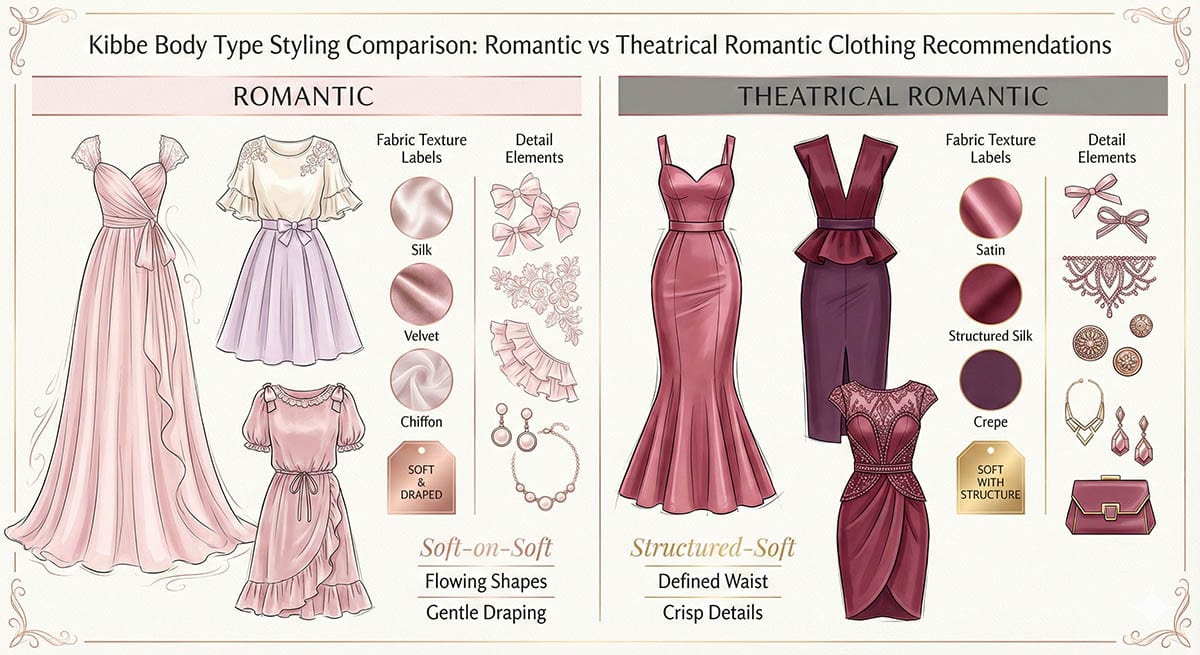 Styling comparison: Romantic's flowing softness vs Theatrical Romantic's structured elegance
Tips for Getting Accurate Results
Determining your Kibbe body type is a journey of self-discovery, and accuracy is important for finding your most flattering style. Here are practical tips to help you identify whether you're Romantic or Theatrical Romantic:
-
Take photos in plain, fitted clothing: Mirror observations can be subjective. Take full-body photos in simple, form-fitting clothes (or a swimsuit) in natural lighting. This provides an objective view of your lines and proportions.
-
Ask for fresh eyes: Sometimes we have biases about our own bodies. Show your photos to someone familiar with Kibbe types or join a reputable Kibbe community for feedback (but remember, you have the final say).
-
Focus on bone structure first: Your skeleton doesn't change with weight fluctuations. Look at your joints, shoulders, hands, and feet for Yang sharpness versus Yin roundness.
-
Try on test garments: Visit a store and try on styles recommended for each type. Which makes you feel most harmonious and "like yourself"? Your body will tell you.
-
Be patient and honest: It's easy to want to be a particular type, but accurate typing comes from honest observation. Both Romantic and Theatrical Romantic are beautiful—there's no "better" choice.
-
Remember that nobody is 100% pure: You'll have individual variations. The goal is to find which type's recommendations feel most natural and look most harmonious overall.
-
Consider professional guidance: If you're truly stuck, consider consulting with a certified Kibbe image consultant who can provide expert analysis.
Most importantly, don't stress over perfect categorization. The Kibbe system is a tool to help you look and feel your best—it should be fun and empowering, not anxiety-inducing!
Related Resources on This Site
To deepen your understanding of these body types and make the most informed styling decisions, explore these helpful pages:
-
Romantic Body Type Guide – Dive deep into the pure Romantic type with detailed styling recommendations, celebrity examples, and a comprehensive breakdown of what makes this type unique. This is essential reading if you think you might be a pure Romantic.
-
Theatrical Romantic Body Type Guide – Explore the nuances of Theatrical Romantic with specific styling advice, examples, and detailed guidance on honoring both your Yin softness and Yang sharpness.
-
Kibbe Body Type Chart – See how Romantic and Theatrical Romantic relate to the other 11 Kibbe types. This visual comparison chart helps you understand where these types fall on the Yin/Yang spectrum and how they differ from similar types like Soft Gamine.
-
Interactive Kibbe Quiz – Still uncertain about your type? Our comprehensive quiz asks targeted questions about your bone structure, flesh, and facial features to help narrow down your body type with confidence.
Each of these resources provides complementary information that builds on what you've learned here, helping you make styling choices that truly celebrate your unique beauty.
Common Questions About Romantic vs Theatrical Romantic (FAQ)
Can I be Romantic if I'm 5'7"?
While the traditional Kibbe height guideline for Romantic is 5'5" and under, height is not an absolute rule. If you're slightly taller but have all the characteristics of Romantic (pure Yin, no Yang sharpness, soft and rounded throughout), you could still be Romantic. That said, taller individuals are more commonly other types like Soft Natural or Soft Classic. Focus on your overall bone structure, flesh, and facial features rather than height alone.
What's the main difference between Romantic and Theatrical Romantic?
The key difference is the presence of Yang elements. Romantic is pure Yin with complete softness and roundness throughout—no sharp or angular features. Theatrical Romantic has a subtle Yang undercurrent, meaning you'll notice slight sharpness or definition (like narrow shoulders, defined cheekbones, or visible bone structure in hands and feet) mixed with predominantly soft features. In styling, this translates to R needing complete softness while TR benefits from structure-meets-softness.
Can a Theatrical Romantic look good in Romantic clothes?
Yes, to some extent! Since both types are Yin-dominant, there's overlap in what works. However, Theatrical Romantics typically look best with slightly more structure and crispness than pure Romantics. A TR might feel overwhelmed or "drowned" in very flowing, shapeless Romantic garments, while a Romantic might feel constricted in TR's more fitted styles. The best approach is to experiment and notice which recommendations make you feel most harmonious and authentic.
How do I know if my curves are Romantic or Theatrical Romantic?
Both types have curves, but the quality differs. Romantic curves are soft, rounded, and continuous—like gentle hills flowing into each other. Theatrical Romantic curves are more compact and defined, with a pronounced waist creating an hourglass effect. TR curves feel "etched" or shaped, while R curves feel lush and flowing. Additionally, TRs tend to maintain visible definition even with weight gain, while Romantics become more rounded overall.
Are there male Romantics and Theatrical Romantics?
Yes! While Kibbe originally created the system for women, the principles apply to all genders. Male Romantics and Theatrical Romantics are less common in Western culture but absolutely exist. They share the same physical characteristics (soft, rounded bone structure with delicate build) and benefit from similar styling principles adapted for menswear—like soft, quality fabrics, rounded details, and avoiding overly sharp or boxy tailoring. Examples might include actors like Elijah Wood or Timothée Chalamet showing Yin-dominant characteristics.
Can I transition from one type to another with weight changes?
No. Your Kibbe body type is determined by your bone structure, which doesn't change with weight fluctuations. What changes is how flesh distributes on your frame. A Romantic will always have Romantic bone structure regardless of weight, and a Theatrical Romantic will maintain those subtle Yang elements. However, dramatic weight changes might make certain features more or less apparent, which is why it's important to assess your bone structure rather than focusing solely on flesh.
What if I have some Romantic features and some that seem like other types?
This is common and why the Kibbe system looks at your overall pattern, not isolated features. If you have mostly Romantic characteristics with a few that seem off, you might be Theatrical Romantic (Yin with Yang touches) or possibly Soft Gamine (mixed Yin/Yang in a more compact frame). Alternatively, you might be Soft Classic (balanced with Yin influence). The key is identifying which type's recommendations feel most harmonious overall. Our body type chart and quiz can help clarify your dominant pattern.
I'm stuck between Theatrical Romantic and Soft Gamine—how are they different?
This is another common confusion point! Both Theatrical Romantic and Soft Gamine are petite types with Yin influence, but they differ in their essential structure. Theatrical Romantic is predominantly Yin with slight Yang sharpness—meaning you're curvy with soft flesh and delicate bones with hints of definition. Soft Gamine, however, is a true Yin/Yang mix with more angular bone structure, compact curves, and a more "broken" or "combined opposites" appearance rather than TR's flowing curves. If you're questioning this distinction, our Soft Gamine body type page can help you understand the key differences in bone structure and styling needs.
Conclusion
Understanding the difference between romantic vs theatrical romantic comes down to recognizing the subtle Yang elements that distinguish Theatrical Romantic from Romantic's pure Yin softness. Both types celebrate feminine curves and delicate bone structure, but Theatrical Romantic adds a touch of sharpness and definition that requires slightly different styling choices.
Remember that the Kibbe system is not about fitting into rigid boxes—it's about understanding your unique physical harmony and dressing in a way that feels authentic and flattering. Whether you're a Romantic who thrives in soft, flowing luxury or a Theatrical Romantic who needs structured softness with ornate details, both types are equally beautiful and worthy of celebration.
If you feel stuck between the two, that's actually completely normal—it usually means you're close on the Yin spectrum, not that you're "doing it wrong." Many people take time to identify their type with certainty, and that's perfectly okay. The differences between R and TR are genuinely subtle, and even experienced typists sometimes need multiple angles and outfit tests to be sure.
Don't be discouraged if identifying your type takes time. Body typing is a skill that improves with practice and observation. The most important thing is that you feel confident and beautiful in what you wear.
Ready to discover your true Kibbe body type with confidence? Take our comprehensive Kibbe body type quiz to get personalized guidance, or explore our detailed type pages for Romantic and Theatrical Romantic to see which recommendations resonate most with you. Your perfect style is waiting to be discovered!