
How to Know Your Kibbe Body Type: Complete Step-by-Step Guide
Struggling to find your Kibbe body type? Learn how to know your Kibbe body type with practical tips, common mistakes to avoid, and a structured quiz approach.
If you have ever stared into a mirror, trying to decide whether your shoulders are "blunt" or "sharp," you are not alone. Learning how to know your Kibbe body type can feel like solving a puzzle without all the pieces. The terminology is unfamiliar, the concepts overlap, and self-perception often clouds the picture.
But here is the truth: finding your type does not have to be a stressful guessing game. While the Kibbe system is nuanced, there are clear, practical steps you can follow to discover your Image Identity (ID). And if the manual approach feels overwhelming, a well-designed Kibbe Body Type Quiz can guide you through the process objectively.
If you are still asking yourself "what is my Kibbe body type" after reading basic definitions, this guide will show you exactly how to find the answer.
In this guide, we will walk through everything you need to know—from understanding the system's fundamentals to avoiding the most common pitfalls—so you can finally answer the question: how do I know my Kibbe body type?
If the quiz gave you a shortlist but you still feel caught between two types, use the Kibbe Type Troubleshooter for a more focused second opinion.
What Is a Kibbe Body Type?
Before we dive into how to find your type, let's establish what we're looking for.
A Kibbe body type is a classification system created by stylist David Kibbe in the 1980s. Unlike traditional sizing systems that rely on measurements (bust, waist, hips), the Kibbe system focuses on the overall impression of your body—specifically, the balance between Yin (soft, rounded, delicate) and Yang (sharp, angular, elongated) characteristics.
There are several main "families" of Kibbe types:
| Family | Description | Key Traits |
|---|---|---|
| Dramatic | Pure Yang | Long vertical line, sharp bones, narrow silhouette |
| Natural | Soft Yang | Broad, blunt bones, relaxed and muscular frame |
| Classic | Balance | Moderate, symmetrical, evenly proportioned |
| Romantic | Pure Yin | Soft, rounded, lush curves, delicate bones |
| Gamine | Mixed Contrast | Petite, compact frame with a mix of sharp and soft |
Within these families, there are subtypes (like Soft Dramatic, Soft Classic, or Flamboyant Gamine) that account for variations. For a visual overview of all 13 types, visit our Kibbe Body Types Chart.
The goal of finding your type is not to limit yourself, but to understand which clothing silhouettes, fabrics, and details will naturally harmonize with your body.
Tip: If you already understand Yin/Yang basics, skip ahead to the step-by-step methods below.
Why It's Hard to Know Your Kibbe Body Type
If you have been trying to self-type and feeling lost, you are experiencing something universal. Here is why how to find out your Kibbe body type is so challenging:
1. We Lack Objectivity About Ourselves
When you look in the mirror, what do you focus on? For most of us, it's our perceived "flaws." You might fixate on "wide hips" or "narrow shoulders" and assign yourself a type based on one feature. But the Kibbe system is holistic—it's about the overall picture, not isolated parts.
2. Weight Fluctuations Obscure the Bone Structure
Many beginners confuse flesh with frame. A Dramatic can gain weight and appear "softer," but their underlying bone structure (long, narrow, sharp) does not change. Similarly, a Romantic at a low weight is still a Romantic. Your type is based on your skeleton and flesh pattern, not your current size.
3. Online Misinformation Is Everywhere
The internet is flooded with oversimplified charts, TikTok "hacks," and outdated Pinterest graphics that often contradict each other. Some rules (like height limits) are misunderstood, and without proper context, beginners get confused or mistyped.
4. The Terminology Is Abstract
Words like "vertical," "width," "curve," and "petite" have very specific meanings in Kibbe, but they are not intuitive. Without understanding these concepts, self-assessment becomes a frustrating exercise in guessing.

How to Figure Out Your Kibbe Body Type
Before you dive into the deep end, check this Quick Decision Shortcut:
- If you consistently read tall and elongated → Focus on the Dramatic, Soft Dramatic, or Flamboyant Natural family.
- If you read balanced and moderate → Focus on the Classic family.
- If you read petite and compact → Focus on the Gamine family.
- Still not sure? → Take the Quiz
Now, if you want to understand the process deeper, here are the three main approaches—each with its own advantages and challenges.
Method 1: Self-Observation and Study
This is the "purist" approach. You study the Kibbe system in depth and analyze your own body.
Steps:
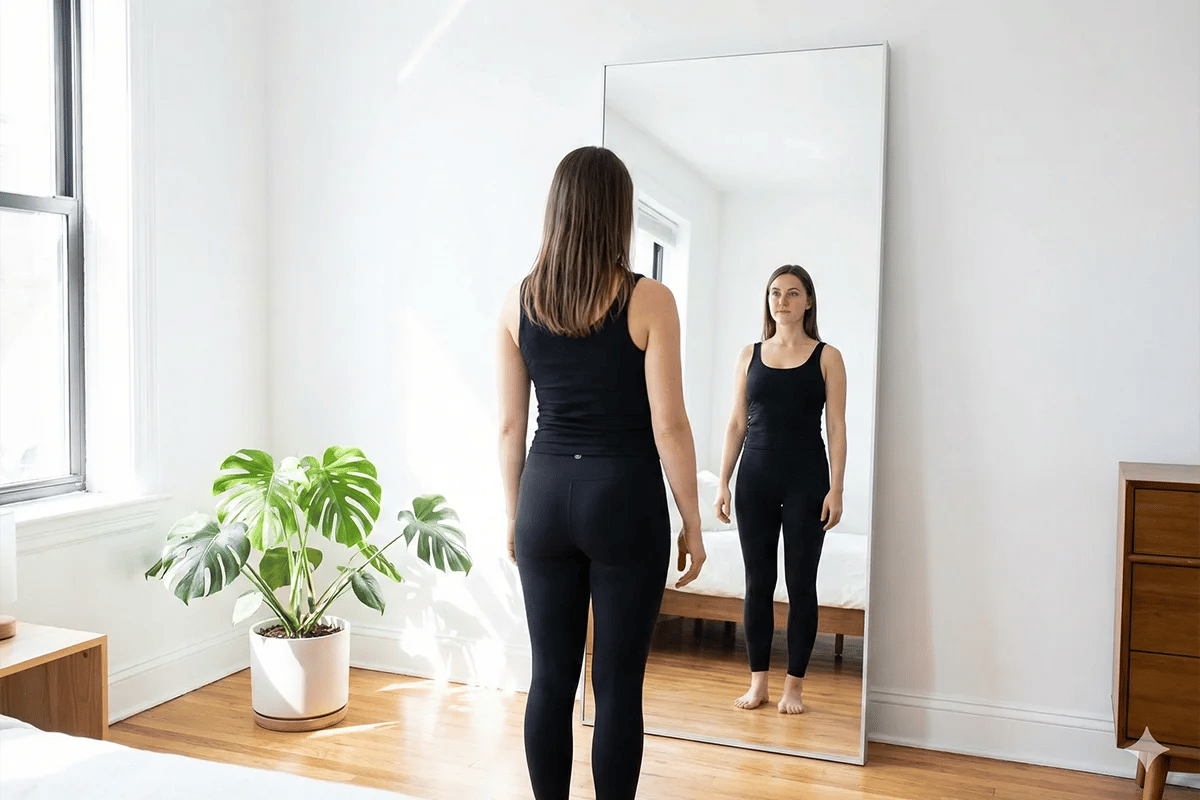
- Stand in front of a full-length mirror in form-fitting, neutral-colored clothing.
- Assess your bone structure: Are your shoulders sharp or sloped? Is your jaw angular or rounded?
- Assess your body flesh: Are you naturally muscular, soft, or somewhere in between?
- Assess your vertical line: Do you appear tall and elongated, moderate, or short and compact?
- Compare your observations to the 13 Kibbe types.
Pros:
- Free and accessible.
- Deepens your understanding of the system.
Cons:
- Highly subjective—most people struggle to see themselves accurately.
- Time-consuming and can lead to frustration.
Method 2: Using Visual Comparison Charts
Another approach is to compare yourself to visual references like our Kibbe Body Type Comparison Chart.
Steps:
- Look at silhouette examples for each type.
- Use the chart to compare one trait at a time (vertical, width, curve), instead of trying to match an entire type at once.
- Try to match your overall impression to a type's silhouette.
Pros:
- Quick visual reference.
- Helpful for understanding how types differ at a glance.
Cons:
- Still subjective—you need to know what to look for.
- Celebrity examples can be misleading (they are styled, lit, and often heavily edited).
Method 3: Taking a Structured Quiz
For most beginners, a well-designed quiz is the most efficient starting point for answering how do I know my Kibbe body type.
How a Good Quiz Works:
- Breaks down abstract concepts (like "vertical" or "width") into observable, concrete questions.
- Uses logic (e.g., if you answer "tall" for height, Gamine types are automatically ruled out).
- Provides a result hypothesis that you can then validate through clothing experiments.
Pros:
- Fast and structured—takes minutes, not weeks.
- Reduces subjective bias by guiding your observations.
- Points you to a likely starting point for further exploration.
Cons:
- Requires honest answers—if you answer based on wishful thinking, the result will be off.
- A quiz is a starting point, not the final word. You still need to test the result in real life.
Ready to find your type? Take Our Free Kibbe Body Type Quiz and get personalized results in minutes.
Is a Kibbe Body Type Quiz Accurate?
You might be wondering: can a simple online quiz really tell me my type?
The honest answer is: a quiz is a diagnostic tool, not a definitive answer. Here's why that's still valuable:
- It narrows the field. Instead of studying all 13 types, you can focus on 2–3 most likely candidates.
- It provides structure. The quiz guides you through the key questions (bone structure, flesh, vertical) so you don't skip important factors.
- It is objective. Unlike staring in the mirror and guessing, a quiz forces you to answer specific, concrete questions.
Think of it this way: the quiz gives you a hypothesis. Your wardrobe becomes your laboratory. Once you know your likely type, you can test it by trying on clothes in that type's recommended lines. If everything flows and feels right, you've likely found your match. If it feels off, you might need to determine your Kibbe type more accurately with further study.
The best quizzes (like ours) also explain why certain answers point to certain types, helping you learn as you go.
What to Do After You Know Your Kibbe Type
Congratulations—you have a result! But what now? Here's how to translate your new knowledge into real-world style:
1. Read Your Type Profile
Start by deep-diving into your specific type. For example, if your result is Soft Natural, visit our Soft Natural Type Page to understand:
- Your dominant characteristics.
- Recommended silhouettes, fabrics, and details.
- Common styling mistakes to avoid.
2. Audit Your Closet
Take a look at your existing wardrobe. Chances are, the clothes you feel best in already align with your Kibbe ID. That favorite dress you always reach for? It probably honors your natural lines.
Identify any pieces that feel "off" and analyze why. Are the lines too long? Too structured? Too fussy? This reverse-engineering helps you internalize your type's recommendations.
3. Explore Your Style Guide
For actionable recommendations, check out our Style Guides section. For example:
These guides provide specific advice on necklines, skirts, jackets, accessories, and more—tailored to your unique lines.
4. Experiment and Iterate
Don't treat your result as a rigid box. The fun of knowing your type is experimentation. Try on the recommended lines, take note of how you feel, and adjust as needed.
Common Questions About Kibbe Body Types
How do I know my body type in Kibbe? ▼
Can I figure out my Kibbe type from photos? ▼
What if I relate to multiple Kibbe types? ▼
How long does it take to find your Kibbe body type? ▼
Is the Kibbe body type system accurate? ▼
Conclusion: Finding Your Kibbe Type Is a Journey, Not a Destination
Learning how to know your Kibbe body type is not about putting yourself in a box. It's about understanding the unique geometry you were born with—and dressing in a way that honors it.
If you have been frustrated by conflicting advice and endless self-analysis, take a step back. You don't need to decode the entire system overnight. A structured tool—like a quiz—can give you a clear starting point, saving you hours of confusion.
Once you have your likely type, the real fun begins: experimenting with clothes, noticing what feels right, and building a wardrobe that makes you feel like the best version of yourself.
Ready to finally answer "what is my body type Kibbe?"
- Take the Free Kibbe Body Type Quiz — Get your personalized result in minutes.
- View the Full Comparison Chart — See all 13 types at a glance.
- Explore All Kibbe Types — Deep-dive into each type's profile and styling recommendations.