
How to Confirm Your Kibbe Body Type: The Ultimate Verification Guide
Not sure if your Kibbe quiz result is right? Learn how to confirm your Kibbe body type with practical verification methods, wardrobe tests, and expert tips.
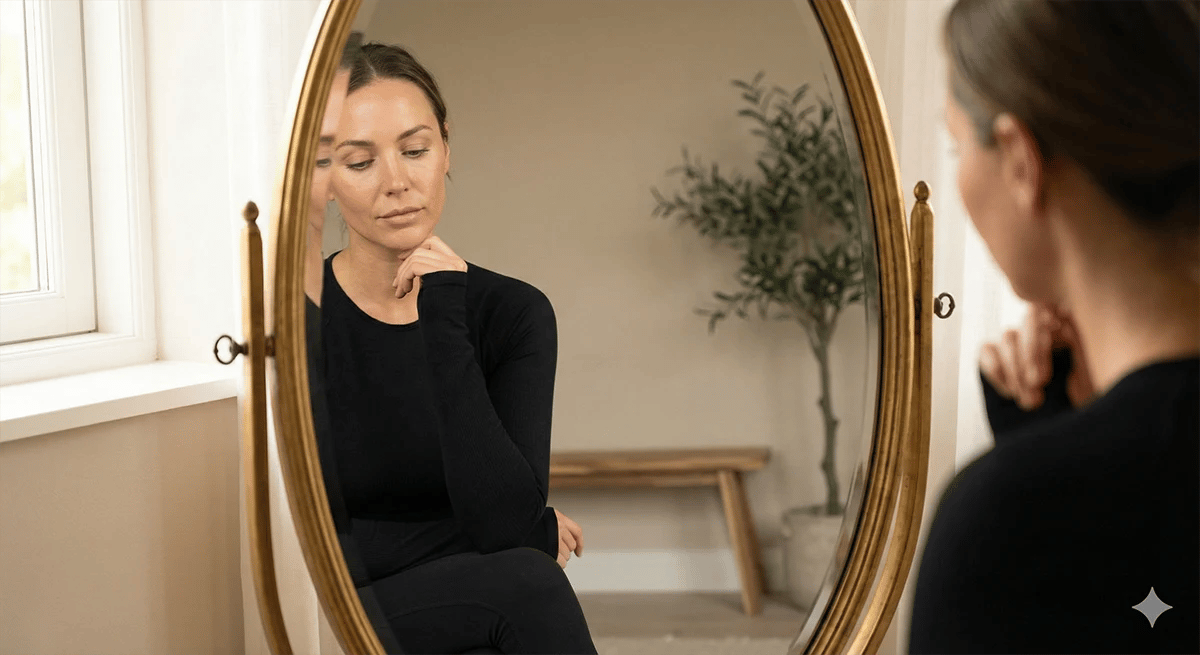
So you have taken a Kibbe body type quiz, read through the descriptions, and landed on a result. But now you are staring at your reflection wondering: Is this actually right?
Learning how to confirm your Kibbe body type is just as important as discovering it in the first place. A quiz gives you a starting hypothesis, but true confirmation comes from testing that hypothesis in the real world—with clothes, with observation, and with honest self-reflection.
If you are second-guessing your result or feeling caught between two types, you are in good company. This is one of the most common struggles in the Kibbe journey. The good news? There are practical, systematic ways to validate your type and finally settle into your Image Identity with confidence.
In this guide, we will walk through proven methods to verify your quiz result, common mistakes that lead to mistyping, and actionable steps to confirm your Kibbe body type once and for all. And if you have not taken a quiz yet, start with our free Kibbe Body Type Quiz to get your initial result before diving into confirmation.
Still split between two likely results? Use the Kibbe Type Troubleshooter to narrow your shortlist and get a clearer next test before you keep reading style guides.
Why Confirming Your Kibbe Type Matters
You might wonder: if I have a quiz result, why do I need to confirm it?
Here is the reality: a quiz—even a well-designed one—is a diagnostic tool, not a final verdict. It narrows down your possibilities and points you toward a likely type. But the Kibbe system is based on the overall impression of your physical geometry, which can be difficult to assess through questions alone.
Confirmation matters because:
- Clothing choices become clearer. When you are confident in your type, shopping decisions become intuitive rather than overwhelming.
- You stop second-guessing. The endless loop of "Am I really a Soft Natural, or maybe a Romantic?" finally ends.
- Your style becomes effortless. Knowing your type means knowing which silhouettes, fabrics, and details will always work for you.
Without confirmation, you risk building a wardrobe based on a misidentified type—and wondering why nothing ever feels quite right.
The 5 Key Areas to Examine When Confirming Your Kibbe Type
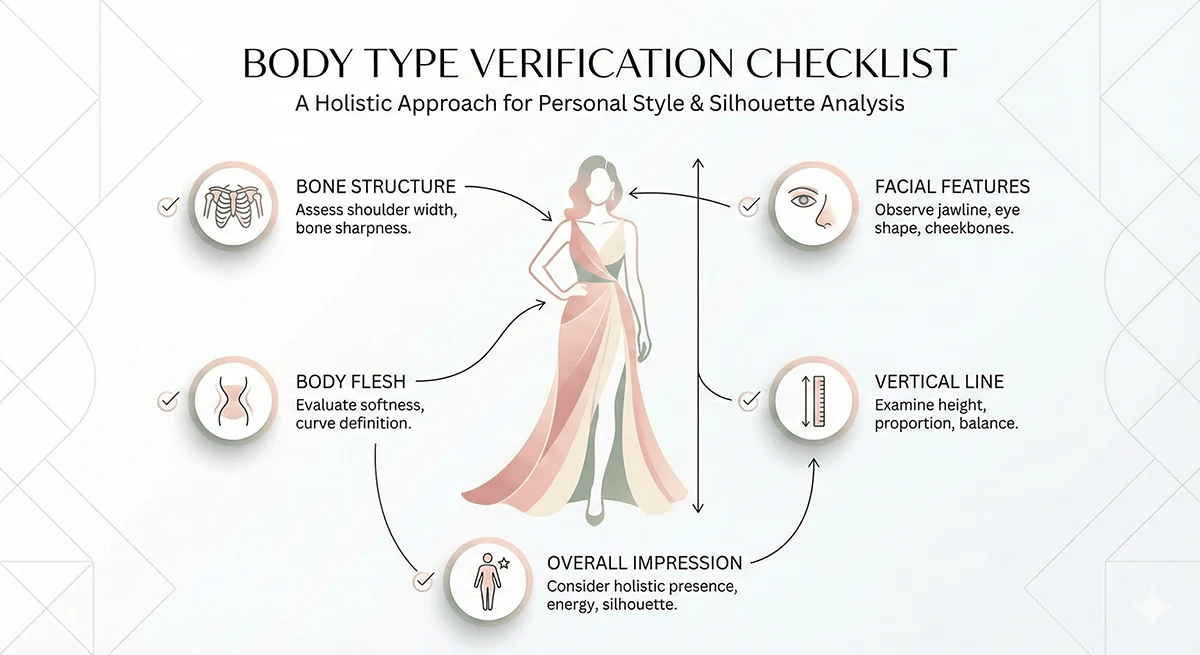
To confirm your Kibbe body type, you need to evaluate yourself across five critical dimensions. These are the same factors the original system uses, approached with fresh eyes and objectivity.
1. Bone Structure
Your skeletal frame is the foundation of your Kibbe type. Unlike flesh, bones do not change with weight fluctuations.
Questions to ask:
- Are my shoulders sharp and angular, or sloped and rounded?
- Is my jawline defined and prominent, or soft and tapered?
- Do my wrists and ankles appear narrow and delicate, or sturdy and blunt?
Confirmation tip: Compare your bone structure to verified examples of your quiz result type. If your bones consistently match the pattern, you are on the right track.
2. Body Flesh
How your flesh sits on your frame reveals your Yin (soft) or Yang (firm) tendencies.
Questions to ask:
- Does my body tend toward soft, rounded curves or taut, athletic lines?
- When I gain weight, where does it distribute first?
- Do my arms and legs appear fleshy or lean?
Confirmation tip: Remember that flesh overlays bone. A Dramatic with some curves is still a Dramatic if the underlying structure is narrow and angular.
3. Vertical Line
Your vertical line refers to whether you appear tall, moderate, or petite—regardless of your actual height.
Questions to ask:
- Do I appear elongated (long limbs, continuous line from head to toe)?
- Am I compact and proportional (equal segments, no clear elongation)?
- Do my limbs appear shorter or longer relative to my torso?
Confirmation tip: Vertical line is about visual impression, not measurement. A 5'4" person can have a long vertical line if their proportions read as elongated.
4. Facial Features
While modern Kibbe de-emphasizes face typing, your facial geometry can still provide confirmation clues.
Questions to ask:
- Are my eyes, nose, and lips larger and lush, or smaller and sharp?
- Is my face shape angular (strong jaw, prominent cheekbones) or rounded (soft cheeks, gentle chin)?
- Do my features have high contrast (mixed sharp and soft) or are they uniform?
Confirmation tip: Look at your face without makeup in natural light. Photograph it straight-on to reduce distortion.
5. Overall Impression
This is the "step back" assessment. When you look at yourself as a complete picture, what is the dominant impression?
Questions to ask:
- If someone were describing me from across a room, what adjectives would they use? (Sharp? Soft? Balanced? Striking?)
- What is my "essence" when all features are considered together?
Confirmation tip: Ask a trusted friend for their honest impression. Others can often see our overall impression more objectively than we can.
How to Confirm Your Kibbe Body Type: Step-by-Step Methods
Now that you understand what to look for, here are practical methods to verify your result.
Method 1: The Wardrobe Test
This is the most reliable confirmation approach. Your clothes become your laboratory.
Steps:
- Gather type-appropriate clothing. Based on your quiz result, find 5-10 pieces that follow your type's recommended lines. Check your type's style guide for specifics.
- Wear them in the real world. Try these pieces for at least one week across different occasions.
- Observe how they feel. Do you receive compliments? Do you feel confident? Does the silhouette harmonize with your natural lines?
- Compare to "wrong" lines. Intentionally try on clothes from a different type's recommendations. If your result type's clothes feel dramatically better, you have confirmation.
Success indicator: When you wear your type's lines, you should feel like you are enhancing your natural appearance, not fighting against it.
Method 2: The Photo Analysis
Photos can reveal what mirrors obscure—our overall silhouette without the distraction of familiarity.
Steps:
- Take a full-body photo. Wear simple, fitted clothing in a neutral color. Stand naturally against a plain background.
- Photograph from a distance. At least 10 feet away, at chest height, to minimize lens distortion.
- Compare to type examples. Place your photo next to verified examples of your supposed type. Look for pattern matches in bone structure and proportion.
- Trace your silhouette. Some people find it helpful to trace the outline of their body to see the actual lines without the distraction of features.
Confirmation tip: Our comparison chart is excellent for side-by-side analysis.
Method 3: The Neighbor Type Comparison
If you are torn between two types, this method brings clarity.
Steps:
- Identify your "neighbor" types. For example, if your result is Soft Classical, your neighbors are Dramatic Classic and Romantic.
- Read all three type descriptions carefully. Note which one resonates most deeply with your lived experience of your body.
- Test all three clothing lines. Spend time wearing each type's recommendations.
- Rate your results. Rank each type's clothes by how well they work. The clear winner is your confirmed type.
Pro tip: Visit our Types overview to explore neighboring types in depth.
Common Mistakes That Lead to Kibbe Mistyping
Before confirming your result, make sure you have not fallen into these common traps:
Mistake 1: Typing Based on Weight, Not Bone
Your Kibbe type is determined by your skeletal structure—not your current weight or body fat percentage. A Dramatic at a higher weight is still a Dramatic. Do not let temporary flesh distribution cloud your bone structure assessment.
Mistake 2: Wishful Thinking
It is human nature to want to be a particular type. But forcing yourself into a category that does not fit leads to a wardrobe full of clothes that never quite work. Be honest about what you see, not what you wish to see.
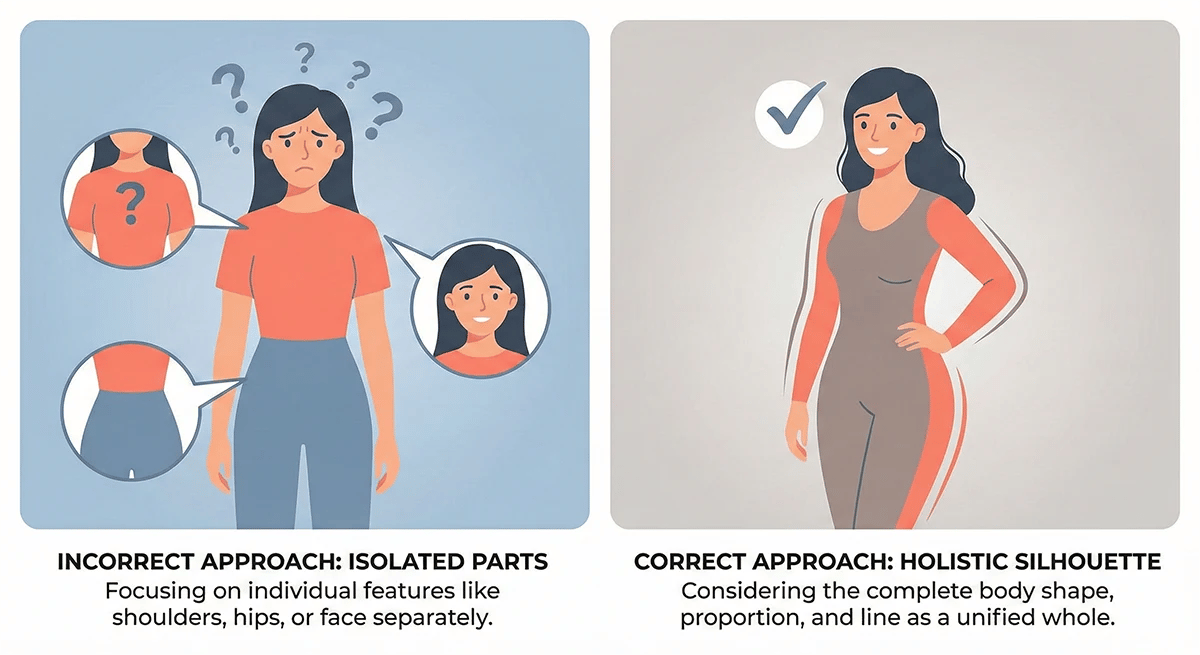
Mistake 3: Focusing on Individual Features
Kibbe is holistic. Having wide hips does not make you a Romantic. Having sharp cheekbones does not make you a Dramatic. Your type is determined by the overall pattern of features, not isolated traits.
Mistake 4: Relying Only on Height
Height influences type possibilities, but it is not determinative. A tall person can be a Soft Dramatic (not just a pure Dramatic), and height limits are guidelines, not hard rules.
Mistake 5: Ignoring Clothing Feedback
If you have been wearing a type's recommended lines and they consistently fall flat, listen to that feedback. Your body is telling you something. A confirmed type should feel natural and flattering.
Tips for Getting Accurate Confirmation Results
Follow these best practices to ensure your confirmation process is objective and reliable:
Use natural lighting. Avoid overhead or harsh artificial light that can create misleading shadows and distort your proportions.
Wear neutral, fitted clothing. Baggy clothes hide your lines. Bright patterns distract the eye. Simple, form-fitting pieces in solid colors give the clearest picture.
Involve an objective observer. Ask a friend or family member to describe what they see. They often notice your overall impression more accurately than you can.
Take your time. Confirmation is not a race. Give yourself permission to spend weeks or even months testing your hypothesis before settling on a final answer.
Trust the clothing feedback. Ultimately, the most reliable confirmation comes from how you feel in type-appropriate clothes. When you find your true type, dressing becomes intuitive and joyful rather than frustrating.
Related Resources on This Site
To support your confirmation journey, explore these helpful pages:
- Our Kibbe Body Type Quiz — If you have not taken it yet, start here to get your initial type hypothesis.
- All 13 Kibbe Types Explained — Deep-dive into each type's characteristics for detailed comparison.
- Kibbe Comparison Chart — Visual side-by-side comparison of all types to help you spot patterns.
- Style Guides — Once confirmed, use your type's specific recommendations for wardrobe planning.
Common Questions About Confirming Kibbe Body Types (FAQ)
How do I know if my Kibbe body type result is correct? ▼
Can my Kibbe body type change over time? ▼
What if two Kibbe types seem to fit me equally well? ▼
How long should I test my Kibbe type before confirming it? ▼
Should I hire a professional to confirm my Kibbe body type? ▼
Conclusion: Confirmation Is the Beginning, Not the End
Learning how to confirm your Kibbe body type is not about finding the "perfect" label—it is about understanding yourself deeply enough to dress with confidence and ease.
Your confirmed type is a tool, not a prison. It gives you a framework for making style decisions, but within that framework, there is endless room for personal expression and experimentation.
If you are still unsure, remember: the confirmation process itself is valuable. Whether it takes you a few days or a few months, the self-awareness you develop along the way will serve your personal style for years to come.
Ready to start—or continue—your confirmation journey?
- Take the Kibbe Body Type Quiz — Get your starting hypothesis if you have not already.
- Explore All 13 Types — Deep-dive into your result and its neighbors.
- View the Comparison Chart — See all types side-by-side for pattern recognition.
Trust the process, trust your body, and trust the clothes. When you find your true type, you will know—because getting dressed will finally feel right.