
Flamboyant Natural vs Natural: Key Differences in Kibbe Body Types
Confused between Flamboyant Natural and Natural? Learn the key differences in bone structure, height, and styling to identify which Kibbe type fits you best.
If you've been exploring the Kibbe body type system, you might find yourself confused between Flamboyant Natural and Natural. Both types share the Natural family's characteristic bone structure width and relaxed essence, but they differ significantly in vertical line, overall proportions, and styling needs.
Understanding the distinction between flamboyant natural vs natural kibbe types is essential for choosing clothing that truly harmonizes with your body's natural lines. In this guide, we'll break down exactly what sets these two types apart, from bone structure to height considerations to styling recommendations.
Whether you're just starting your Kibbe journey or refining your understanding, this article will help you identify which Natural type best describes you. If you're still uncertain about your type, you can explore all 13 Kibbe body types to see where you fit in the broader system.
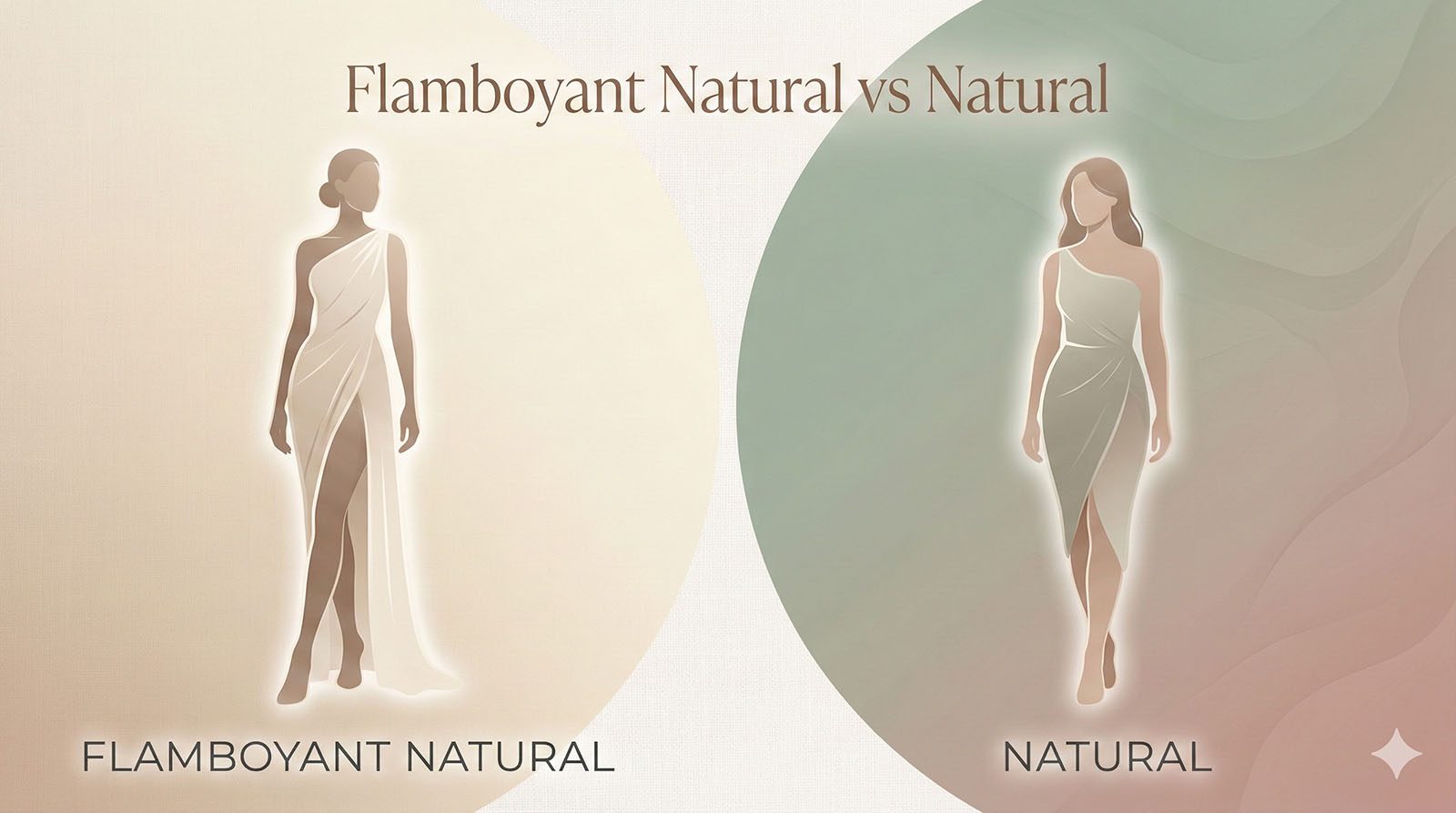
Understanding the Natural Family in Kibbe
Before diving into the differences, it's important to understand what makes a body type part of the Natural family in David Kibbe's system.
The Natural family is characterized by:
- Blunt, angular bone structure with width (especially in shoulders)
- Yang-dominant skeletal frame (meaning more angular, broad features)
- Moderate to no waist definition in the bone structure itself
- A relaxed, unconstructed essence that resists overly tailored or restrictive clothing
Within this family, there were originally three types: Natural, Flamboyant Natural, and Soft Natural. However, David Kibbe discontinued the pure "Natural" classification in his more recent work, leaving only Flamboyant Natural and Soft Natural as official designations.
That said, many Kibbe enthusiasts and earlier resources still reference "Natural" (sometimes called "Natural Classic") as a middle ground between the two remaining types. For clarity, this article uses "Natural" to refer to this moderate Natural body type with balanced yang and some vertical moderation.
Key Physical Differences: Flamboyant Natural vs Natural
Understanding the physical distinctions between Flamboyant Natural and Natural will help you identify your type more accurately.
Bone Structure and Width
Flamboyant Natural:
- Strong, broad bone structure with pronounced width
- Angular, blunt bones (not delicate or rounded)
- Wide, often square shoulders
- Large hands and feet relative to height
- Strong, defined jawline and facial features
Natural:
- Moderate bone structure with noticeable width
- Angular bones but less pronounced than FN
- Shoulders have width but not dramatically broad
- Hands and feet are proportionate, not particularly large
- Facial features are balanced between yang and yin
Vertical Line and Height
Flamboyant Natural:
- Long vertical line - appears elongated even at moderate heights
- Typically 5'5" (165 cm) and above, though exceptions exist
- Height is visually emphasized by long limbs
- Creates an overall impression of tallness and openness
Natural:
- Moderate vertical line - balanced, neither particularly short nor long
- Usually between 5'4" to 5'7" (162-170 cm), though this is not a strict rule
- Proportionate limbs without extreme length
- Creates an impression of athletic balance
Body Flesh and Muscle
Flamboyant Natural:
- Lean flesh that doesn't easily appear soft
- Muscle definition shows easily
- Tends to look athletic or sinewy
- Weight gain is distributed broadly and evenly
Natural:
- Moderate flesh with slight softness possible
- Muscle tone is visible but not as pronounced as FN
- Appears athletic but not overly muscular
- Weight gain is distributed moderately
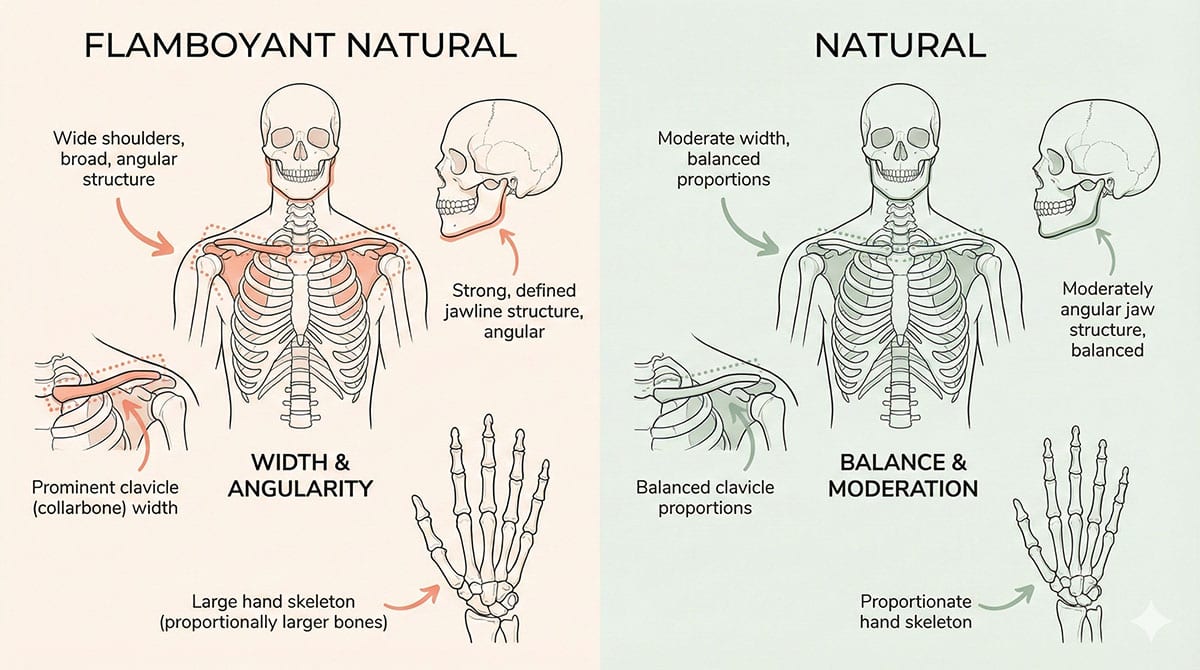 Detailed bone structure differences: FN shows broader shoulders and stronger angular features, while Natural displays moderate proportions
Visual Comparison: What to Look For
When trying to distinguish between these types, observe these key visual cues:
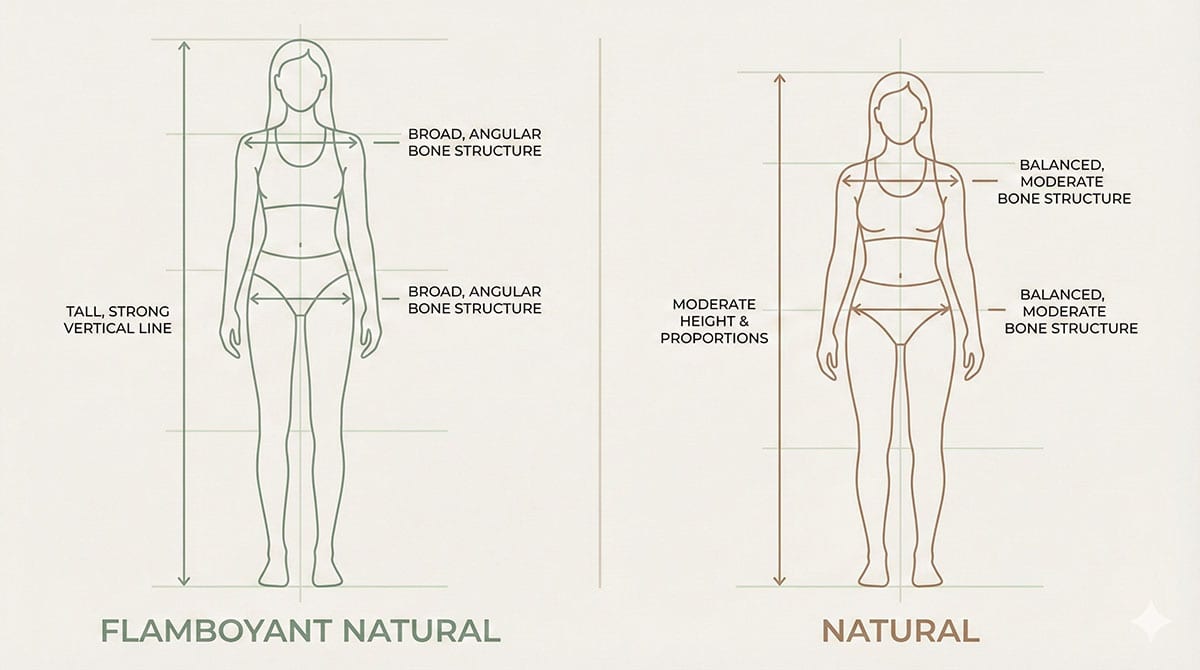 Visual comparison showing the difference in vertical line and bone structure between Flamboyant Natural (left) and Natural (right)
| Feature | Flamboyant Natural | Natural |
|---|---|---|
| Overall Impression | Tall, strong, elongated | Moderate, balanced, athletic |
| Vertical Line | Long, requires accommodation | Moderate, doesn't dominate |
| Shoulder Width | Very broad, pronounced | Moderately broad |
| Bone Structure | Large, angular scale | Moderate angular scale |
| Limbs | Long, especially arms and legs | Proportionate length |
| Styling Needs | Loose, elongated silhouettes | Relaxed with moderate length |
If you find yourself struggling to see these differences in your own body, consider checking out our detailed pages for Flamboyant Natural and Natural types, which include celebrity examples and visual references.
Styling Differences: Dressing Each Type
While both types benefit from unconstructed, relaxed clothing, their styling approaches differ based on their unique physical characteristics.
Flamboyant Natural Styling Principles
Best Clothing Characteristics:
- Long, straight lines that honor the vertical
- Loose, oversized silhouettes (but not shapeless)
- Bold, angular details (sharp lapels, geometric patterns)
- Minimal waist emphasis - avoid cinching
- Natural, textured fabrics (linen, raw silk, heavy cotton)
Avoid:
- Overly tailored, fitted clothing
- Short, cropped lengths
- Delicate, fussy details
- Clingy or body-hugging fabrics
- High necklines that cut vertical line
Natural Styling Principles
Best Clothing Characteristics:
- Moderate lengths - not too long or too short
- Relaxed fit with some shaping - not completely boxy
- Simple, clean lines with subtle detailing
- Balance between structure and ease
- Natural fabrics that have body but aren't stiff
Avoid:
- Extremely oversized or extremely fitted items
- Overly ornate or fussy details
- Very short or very long hemlines
- Highly structured, rigid tailoring
- Overly delicate or clingy fabrics
The key difference: Flamboyant Natural needs maximum length and looseness to accommodate vertical and width, while Natural needs moderation in both fit and length.
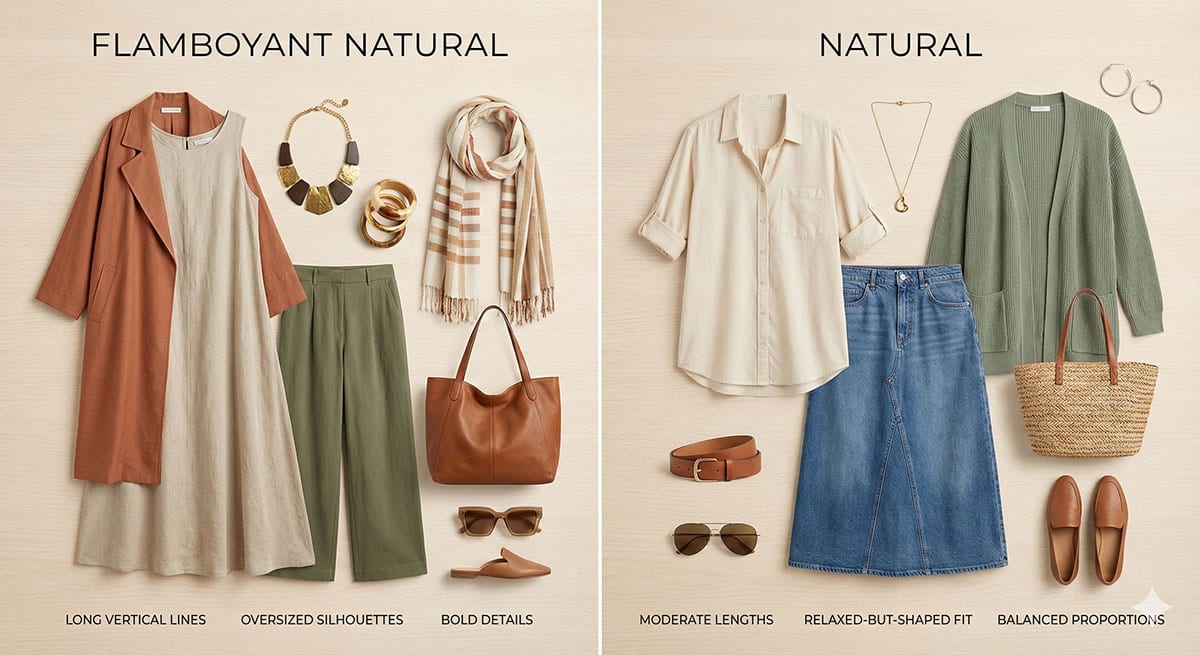 Outfit recommendations: FN styling emphasizes long lines and oversized silhouettes, while Natural styling features moderate lengths and balanced fits
Common Confusion Points
"I'm 5'6" - Am I Too Short for Flamboyant Natural?"
Height alone doesn't determine your Kibbe type. While most Flamboyant Naturals tend to be moderate to tall in actual height, what matters more is your visual vertical line. If you have a strong, long vertical impression even at 5'6", you could still be Flamboyant Natural.
Remember, David Kibbe has moved away from strict height requirements in recent years. Focus on how you appear overall rather than just your measured height in inches.
"I Have Wide Shoulders - Does That Make Me Flamboyant Natural?"
Not necessarily. Both types have shoulder width as a Natural family trait. The distinction is in the degree of width and how it combines with vertical line. Natural has width but with moderation, while Flamboyant Natural has pronounced width with elongation.
"Can I Mix Recommendations from Both Types?"
While it's tempting to cherry-pick from different type recommendations, this often leads to less harmonious results. It's better to commit to one type's guidelines and adjust based on your personal preferences within that framework.
If you're truly between types, you're more likely a Natural, as Flamboyant Natural requires clear yang dominance with strong vertical.
Tips for Accurate Type Identification
Identifying your correct Kibbe type takes careful observation and honesty about your physical structure. Here are some practical tips:
-
Look at yourself in a full-length mirror without trying to pose. What's your first, most automatic impression? Tall and open, or moderate and balanced?
-
Consider how clothes fit you off the rack. Do you need extra length consistently (FN), or do standard lengths work well (N)?
-
Ask yourself about your bone structure. When you touch your bones, do they feel quite large and blunt (FN), or moderately angular (N)?
-
Think about your natural movement style. Flamboyant Naturals often have a more expansive, athletic quality, while Naturals have fluid but more contained movement.
-
Review celebrity examples of each type to see which resonates more with your overall physical impression.
If you're still torn between these two types after self-observation, our step-by-step Kibbe quiz helps evaluate vertical line, width, and overall scale objectively—covering exactly the dimensions we've discussed in this comparison.
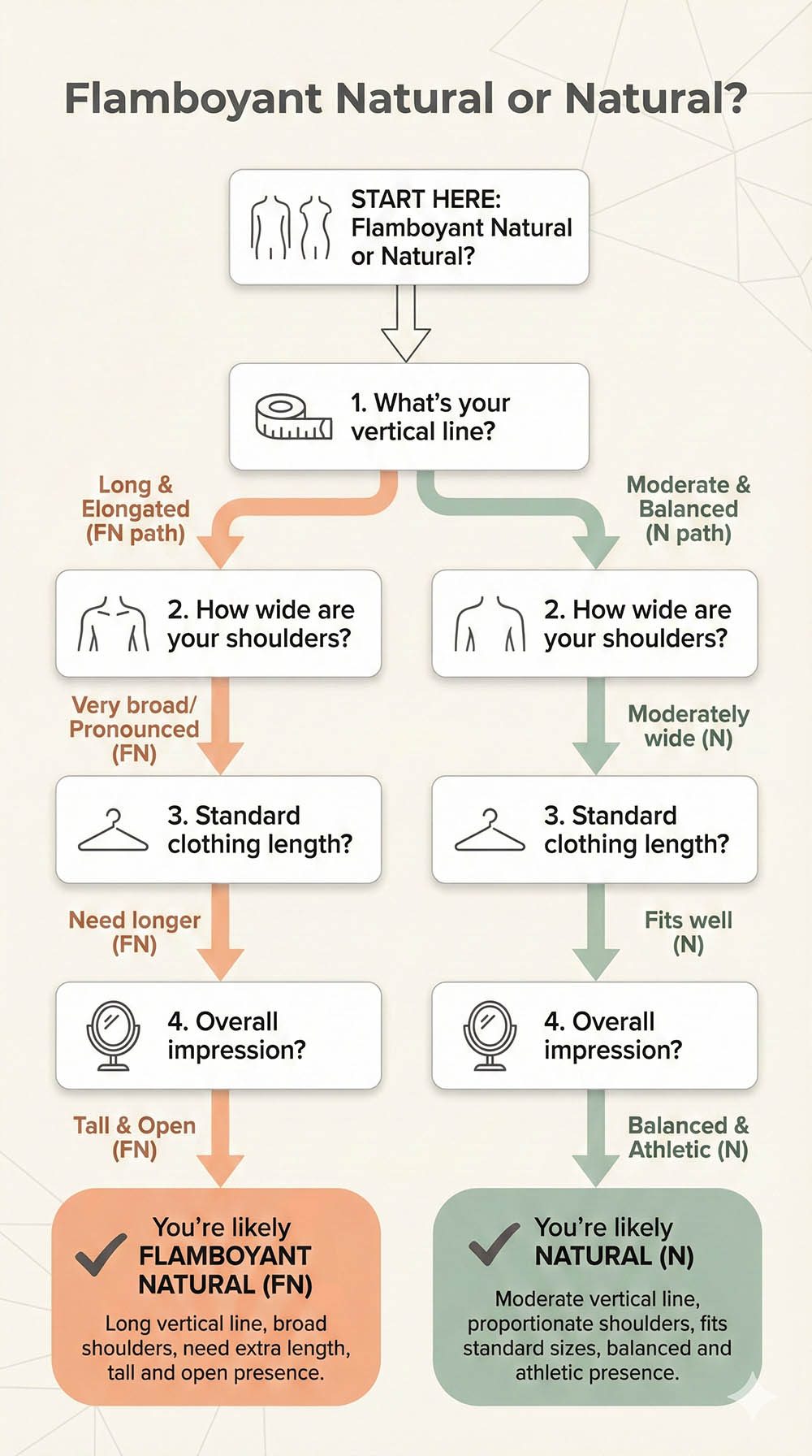 Step-by-step decision guide to help you determine whether you're Flamboyant Natural or Natural based on key physical characteristics
Most importantly, remember that finding your Kibbe type is about understanding your body's natural geometry, not about judging or changing it. Both Flamboyant Natural and Natural are beautiful body types with their own unique strengths.
Related Resources on This Site
To help you further explore these body types and confirm your classification:
-
Flamboyant Natural Style Guide - A comprehensive guide with celebrity examples, detailed styling recommendations, and visual references to help you see if this type matches your physical characteristics.
-
Natural Style Guide - Explore the moderate Natural type with specific styling advice, fabric recommendations, and examples to compare against your own body structure.
-
Kibbe Body Type Chart - See all 13 Kibbe types at a glance and understand how Flamboyant Natural and Natural fit into the broader Kibbe system. This overview helps you see the complete spectrum and rule out other possible types.
These resources provide visual examples and practical guidance that complement the comparison in this article, giving you multiple perspectives to make an informed determination.
FAQ: Flamboyant Natural vs Natural Questions
What's the main difference between Flamboyant Natural and Natural? ▼
Can a short person be Flamboyant Natural? ▼
If I like oversized clothes, does that automatically make me Flamboyant Natural? ▼
How do I know if I'm Natural or Flamboyant Natural? ▼
Do Flamboyant Natural and Natural need different clothing styles? ▼
Can I be between Natural and Flamboyant Natural? ▼
Why did David Kibbe discontinue the "Natural" type? ▼
Which type is more common: Flamboyant Natural or Natural? ▼
Conclusion
Understanding the difference between flamboyant natural vs natural comes down to recognizing the degree of vertical line and yang in your physical structure. Flamboyant Natural brings strong elongation and pronounced bone width, requiring loose, long-lined clothing. Natural offers balanced proportions with moderate width, working best with relaxed but not extreme silhouettes.
Remember, there's no "better" type between the two. Each has its own inherent beauty and styling strengths. The goal isn't to fit into a type you wish you were, but to accurately identify and celebrate the type you are.
If you're deciding between Flamboyant Natural and Natural, the most reliable next step is to evaluate your vertical line in isolation—before thinking about clothing preferences or personal style. Stand in front of a full-length mirror and ask: does your body create a long, continuous line that draws the eye up and down, or does it appear more balanced and moderate in length? This single observation is often the clearest differentiator.
Finding your true Kibbe type empowers you to make clothing choices that feel effortless and look harmonious. Instead of fighting against your natural lines, you can work with them for maximum confidence and style.
Ready to confirm your Kibbe body type? Explore all 13 types and take our comprehensive quiz to discover exactly where you fit in the Kibbe system. Understanding your unique physical geometry is the first step to a wardrobe that truly works for you.